
Long read 04 / Archaeology & place
A lake of bones. One story, or many?
High in the Indian Himalaya, hundreds of human remains lie around Roopkund. For decades they seemed to tell one story. DNA and radiocarbon dates reveal several—and leave the most unexpected travellers unexplained.
In this story
- The thaw
- Why a small lake matters
- Getting there: five days on foot
- 1942: a report from the snow
- The first explanations
- What the villages remember
- The goddess’s journey
- What lay among the bones
- 2004: the hailstorm
- 2019: reading the bones themselves
- Timeline
- The reaction
- Who were the people of group B?
- After 2019
- A site being emptied
- What we know, what we infer, what we don’t
- What would change the answer
- The open question
The thaw
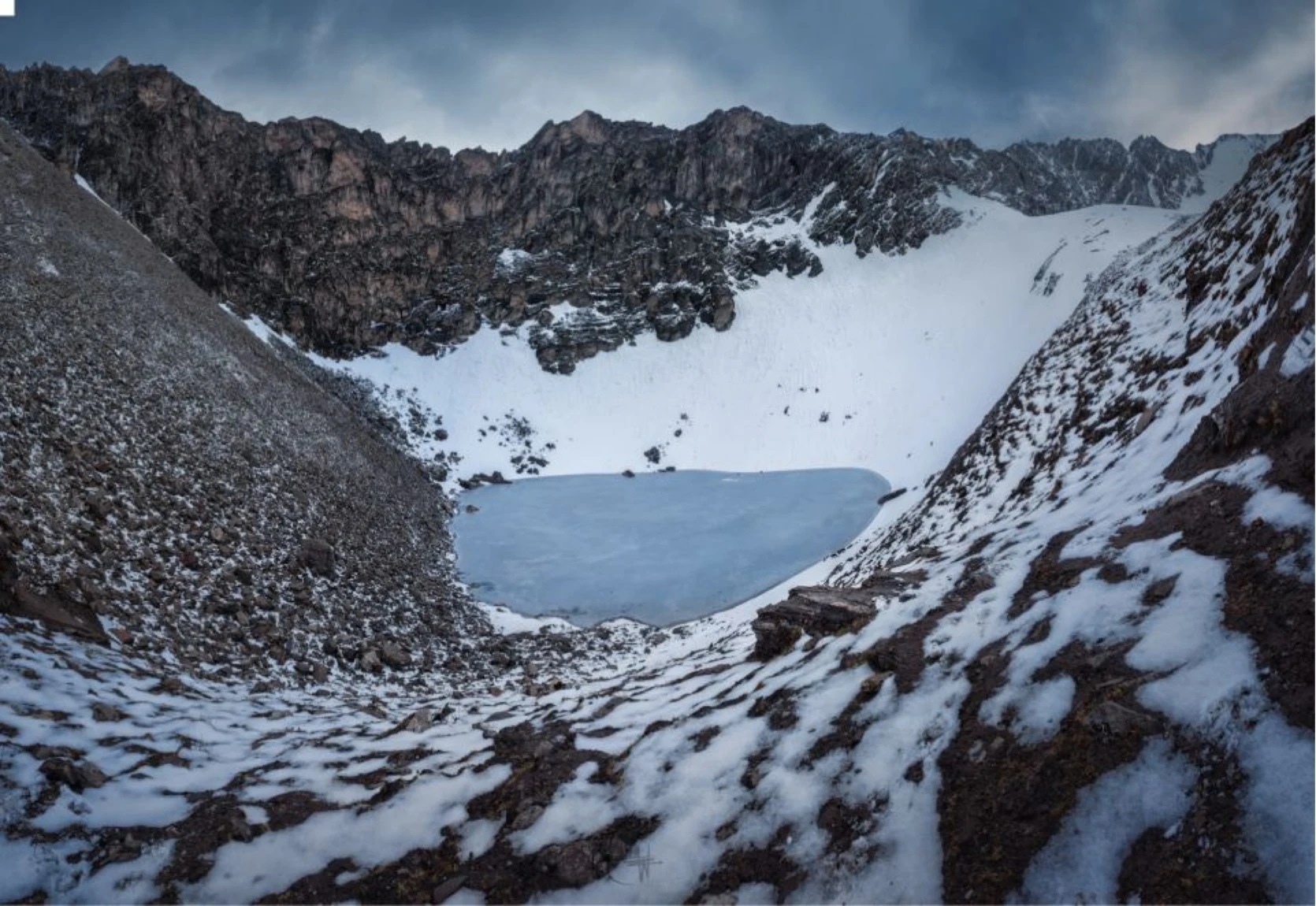
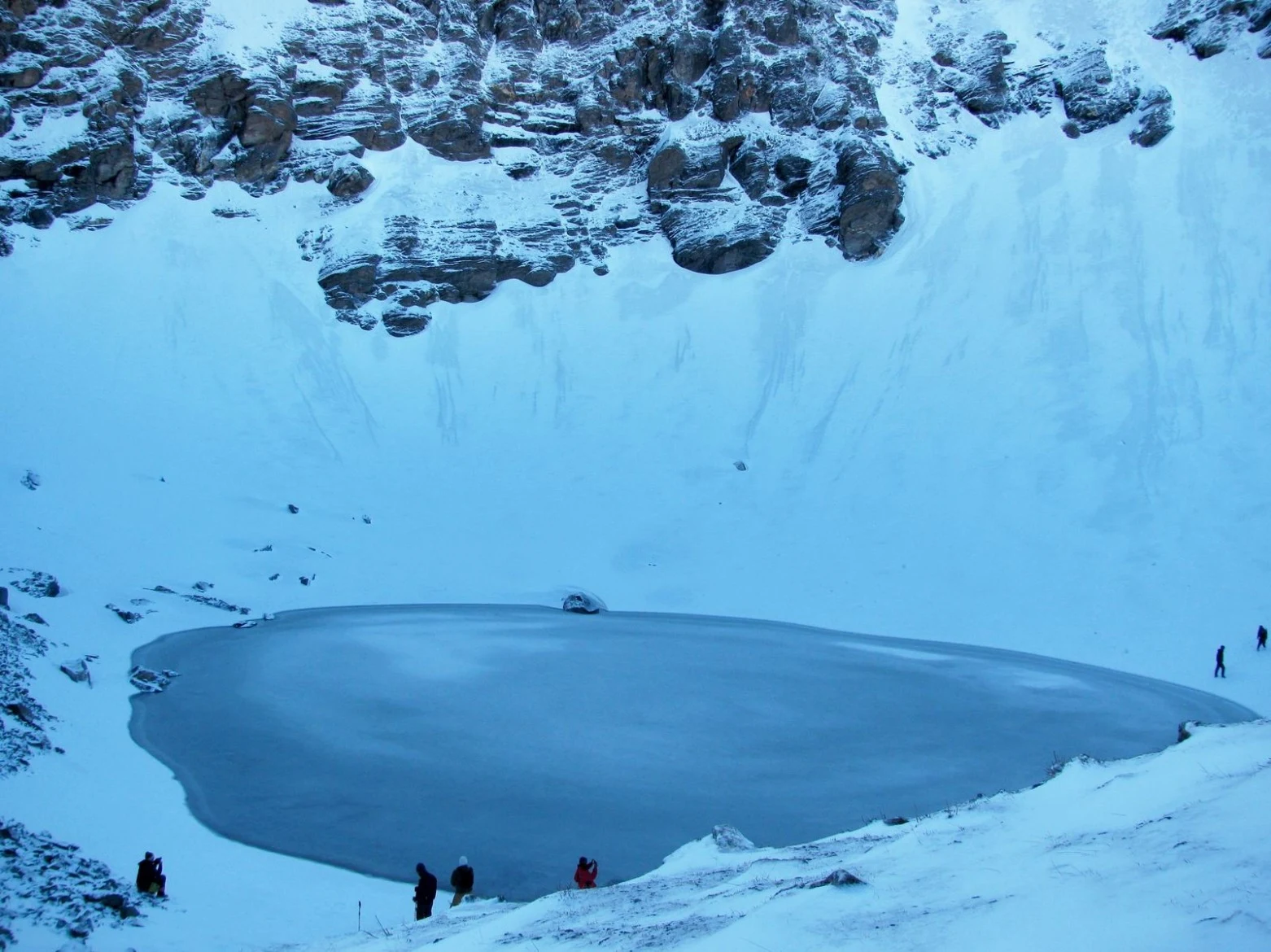
For much of the year, snow conceals the lake and its remains. Roopkund is a glacial tarn in a bowl of rock and ice, and it spends the long Himalayan winter frozen and buried under snow. It is small, about forty metres across by the measure of the scientists who studied it most recently, and the New Yorker’s Douglas Preston put it at roughly a hundred and thirty feet across and ten feet deep. 1, 2 The name is usually glossed as “beautifully shaped lake.” 2
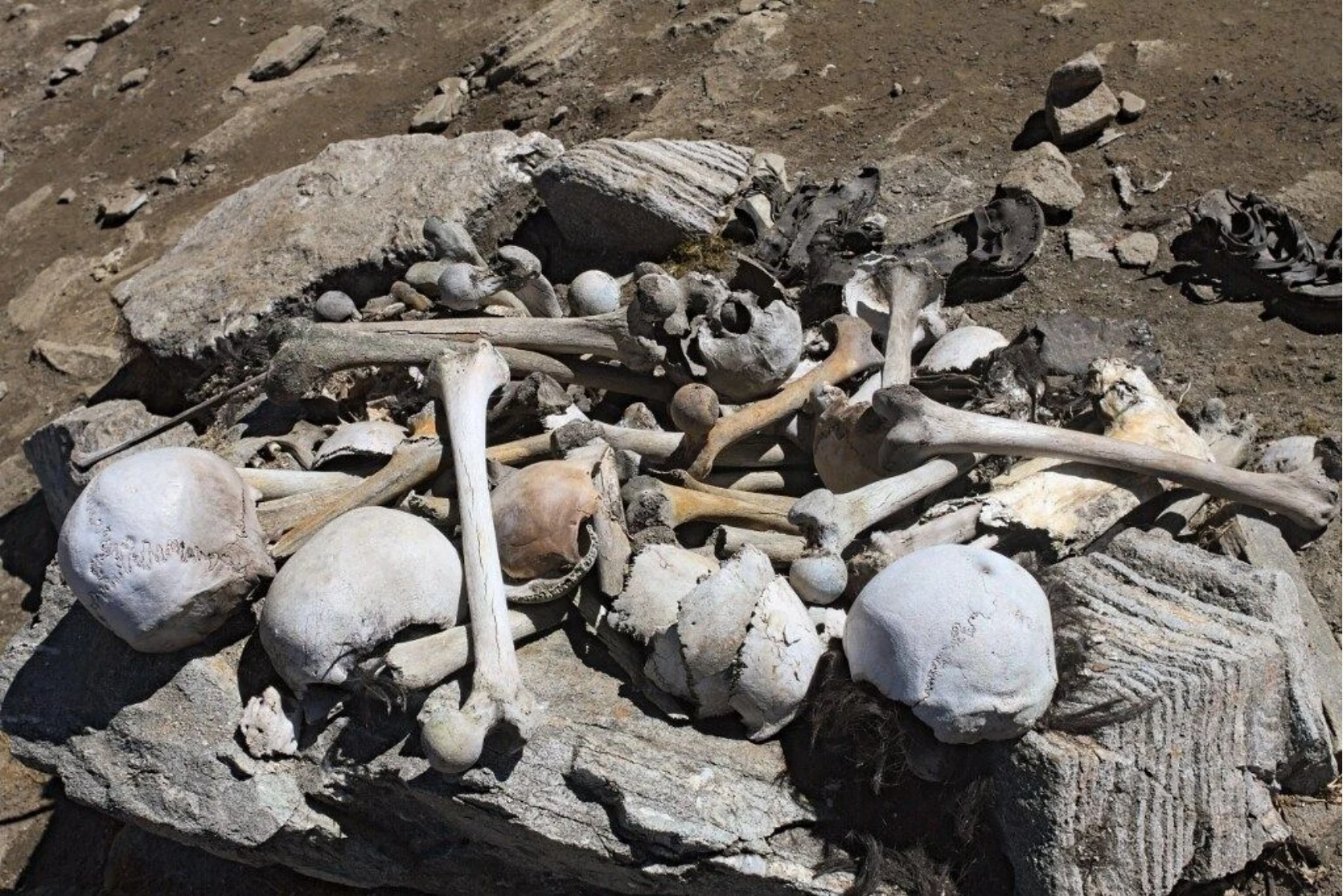
Then, for a few weeks, the snow loosens its grip. The lake expands and shrinks with the season and the weather, and when the snow melts, the bones appear. 3 They lie along the shore, among the scree, and in the shallow water, where in a clear summer they can be seen resting on the bottom. 2 Skulls, long bones, fragments of ribs and jaws. Some remains have been found with flesh still attached. 3 One team came upon the body of a woman bent double beneath a slab of rock, intact, with skin and flesh still on her. 2
It is colloquially known as Skeleton Lake. 1 The local government, in its tourism material, calls it a “mystery lake.” 3 National Geographic once described it as one of archaeology’s spookiest mysteries. 4 Those labels are easy to understand. What is harder, and more interesting, is to ask exactly what kind of mystery it is: which parts of the story have been established, which have been inferred, and which remain open.
This is a story with several layers. There is a place, reached only on foot. There is a goddess, and a pilgrimage that has crossed this ridge for longer than anyone can document. There is a wartime report, a run of confident explanations, a forensic investigation that seemed to close the case, and a genetic study that reopened it. And there is a site that has been picked over for decades, so that every new answer has to be drawn from less evidence than the last.
Why a small lake matters
Roopkund matters first because of what it holds. Estimates of the number of dead vary from about three hundred to eight hundred people, depending on who is counting and when. 2, 5, 3 That is a remarkable number of dead for a place five days’ walk from the nearest village. 2
It matters, too, because it is not a neutral place. The lake lies on the route of the Nanda Devi Raj Jat, a Himalayan pilgrimage to the goddess Nanda Devi that is held roughly every twelve years, and the villages below have long had their own explanation for the bones. 1, 5, 2 Any account of what happened here is also, in some measure, an account of people’s faith and their memory.
And it matters as a test case. In 2019 a team of 28 researchers from institutions in India, the United States and Germany published a study in Nature Communications that combined ancient DNA, radiocarbon dating and the chemistry of bone. 3, 1 Their results ruled out a single catastrophe as an explanation for all the sampled dead. Roopkund shows, unusually clearly, how a satisfying story can form around partial evidence, and what happens when new methods are applied to old bones.
Getting there: five days on foot
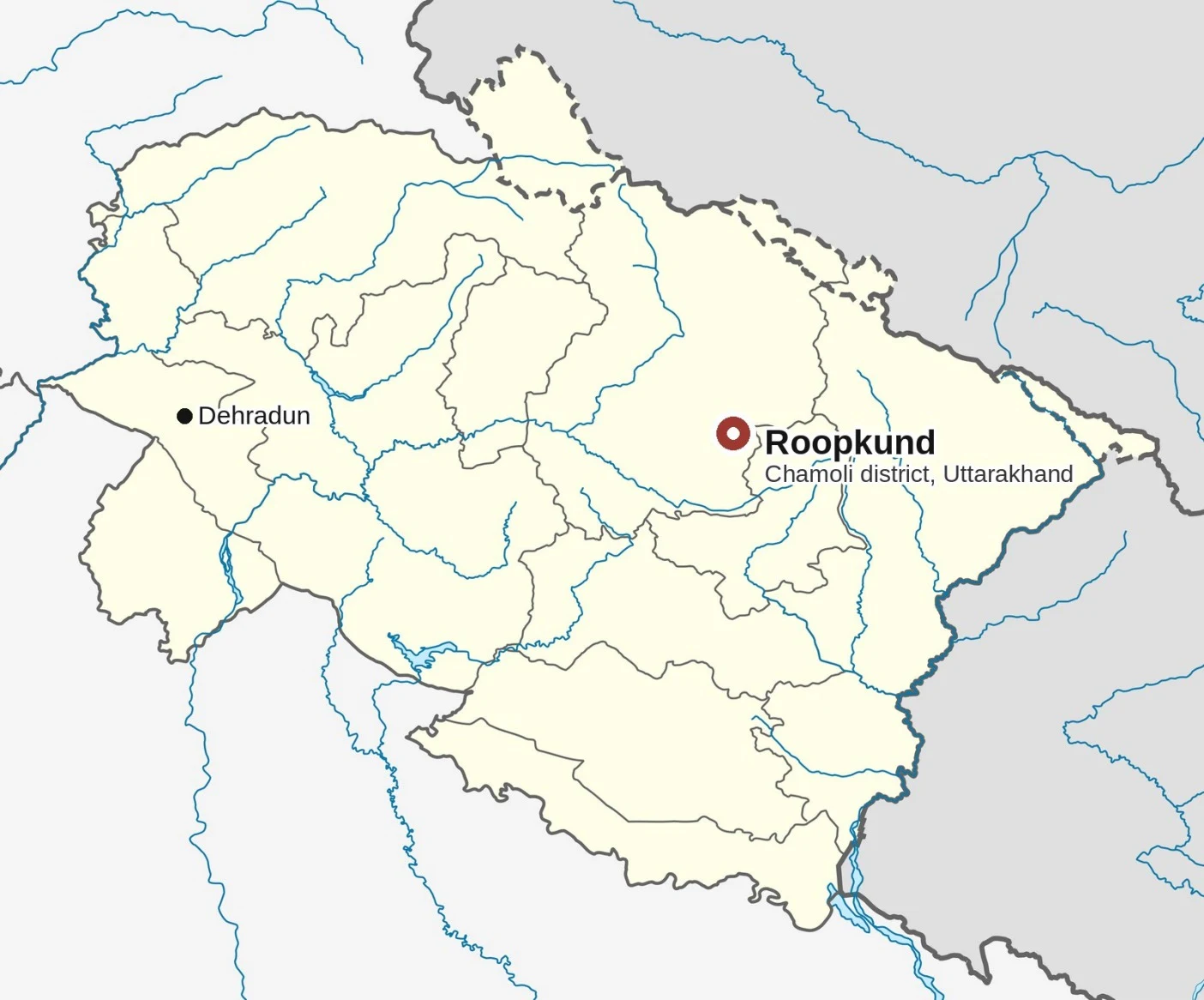
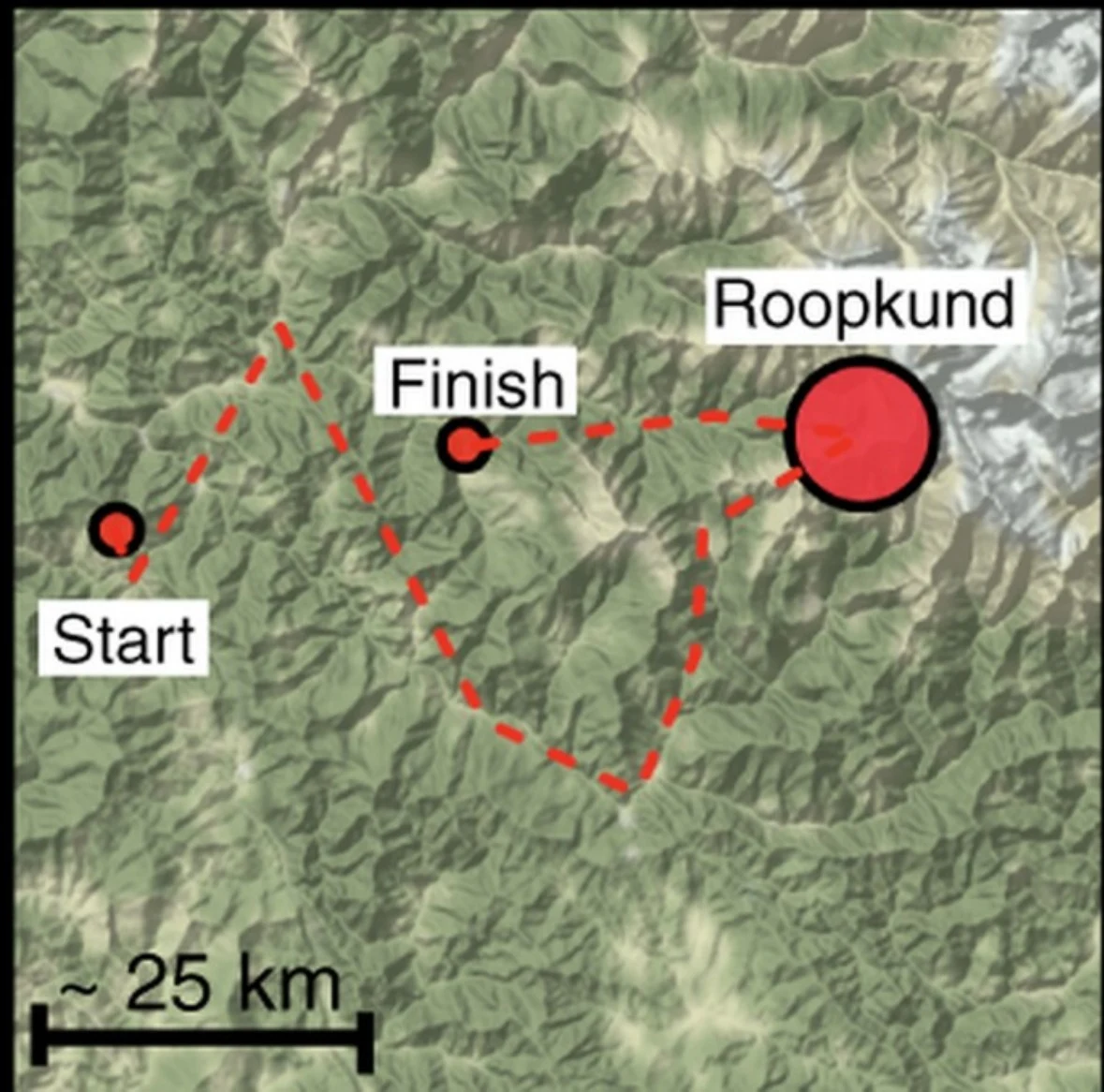
Roopkund lies in the Chamoli district of Uttarakhand, at the foot of a steep slope on Trisul, one of India’s highest mountains. 3 The 2019 paper gives its altitude as 5,029 metres. 1 Trekking guides and some travel writers give a lower figure, around 4,800 metres, so the number you read depends on whom you read. 5, 6 Either way, it is an arduous five-day walk from the nearest habitation. 2
The usual trek begins at Lohajung, a village that court papers describe as the base camp for Roopkund. 8 From there the path climbs through the village of Didna and a forest of oak, rhododendron and pine, then breaks out above the tree line into the bugyals: the high alpine meadows of Garhwal, grazing land for sheep and goats. 8, 6 The BBC’s Neelima Vallangi, who walked it in 2009, described mist- and moss-covered oak forest giving way to expansive, wildflower-laden pastures, with the high peaks coming into view and dominating the horizon for days. 5
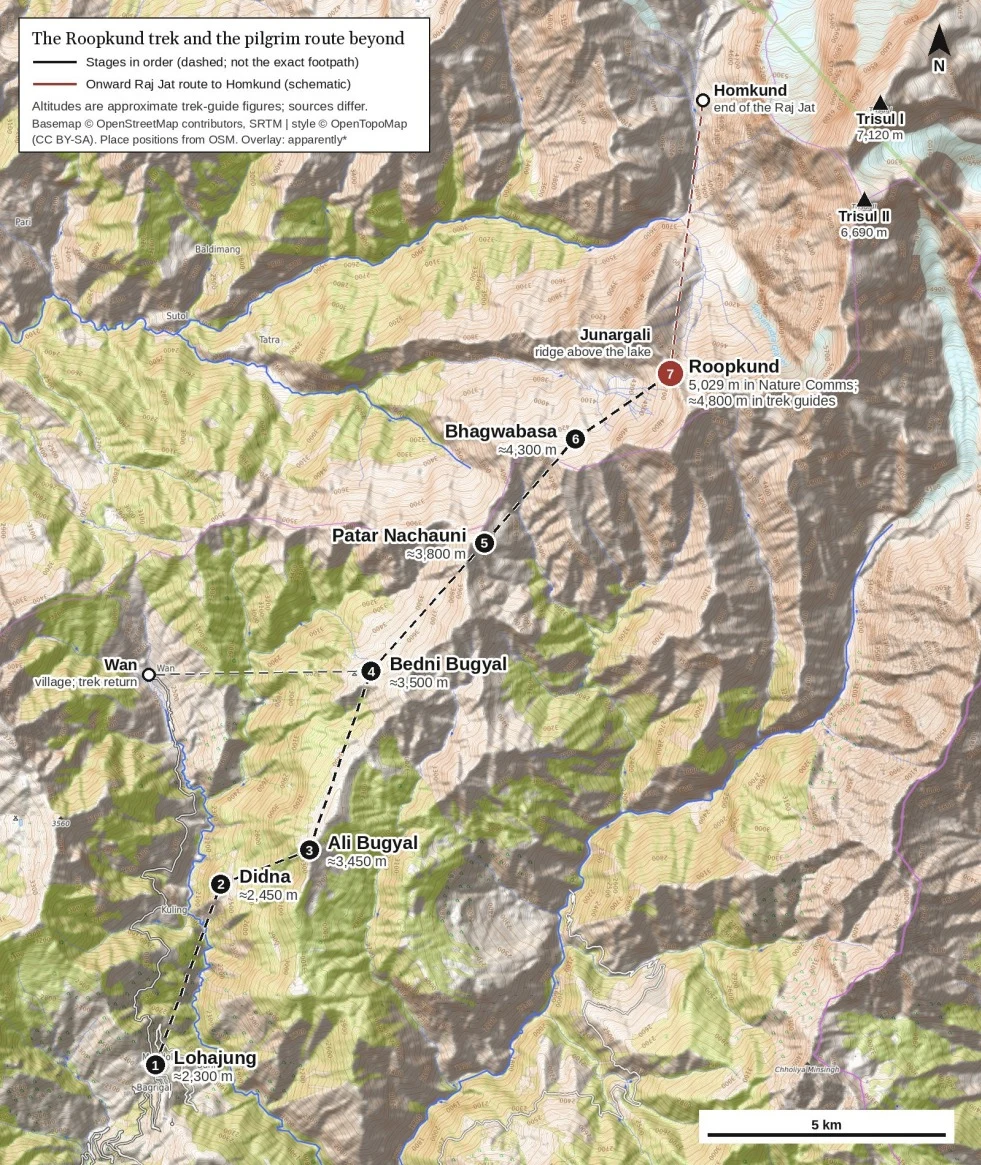
A typical commercial itinerary, which is how most trekkers know the route, runs from Lohajung (about 2,300 metres) to Didna, then up to Ali and Bedni Bugyal (about 3,500 metres), on to Patar Nachauni (about 3,800 metres), and to a high camp at Bhagwabasa (about 4,300 metres) before the final climb to the lake. The walkers usually come down a different way, through Wan. 6 These are operator figures, rounded and approximate, and they vary from one company to the next.
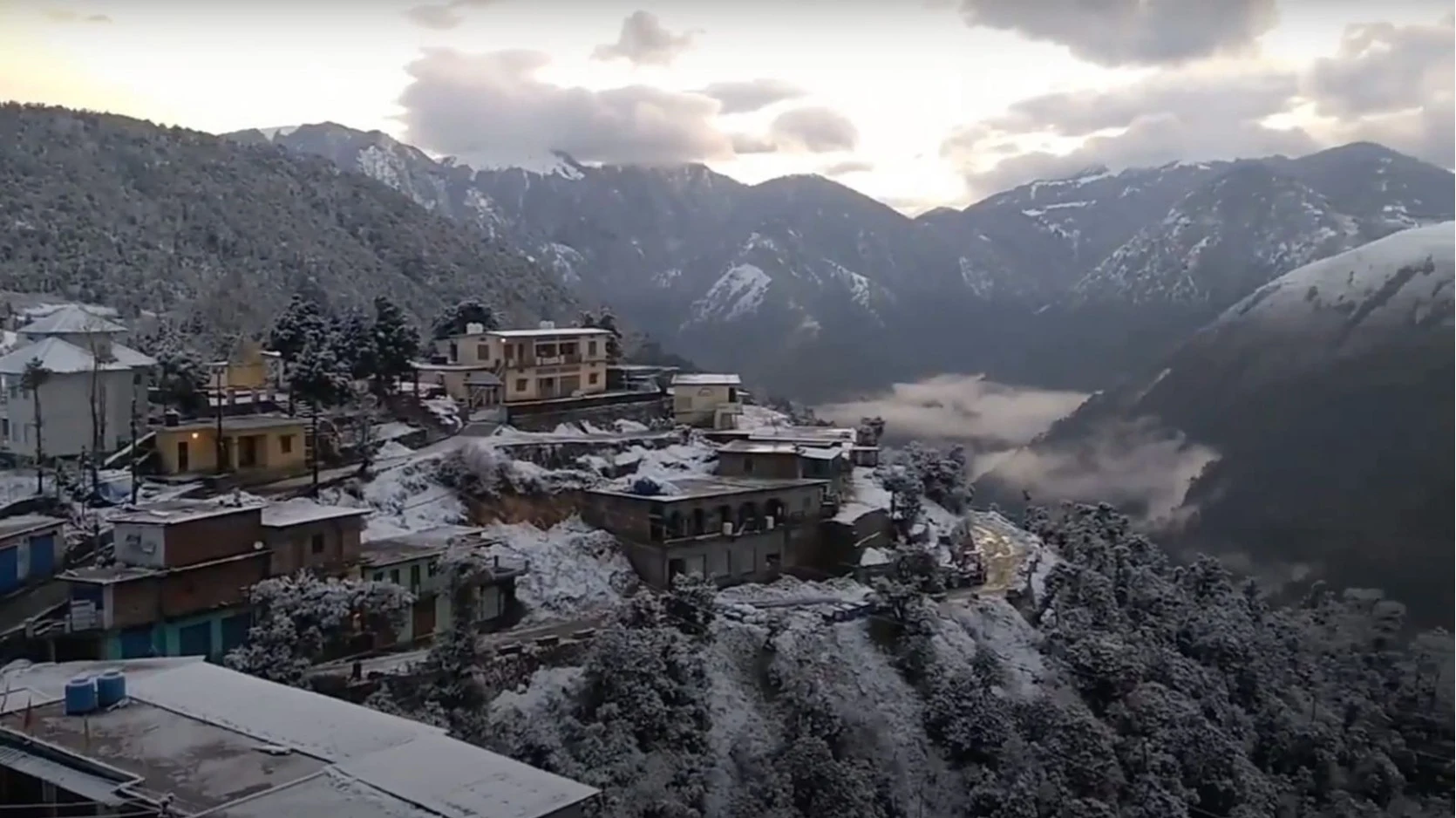
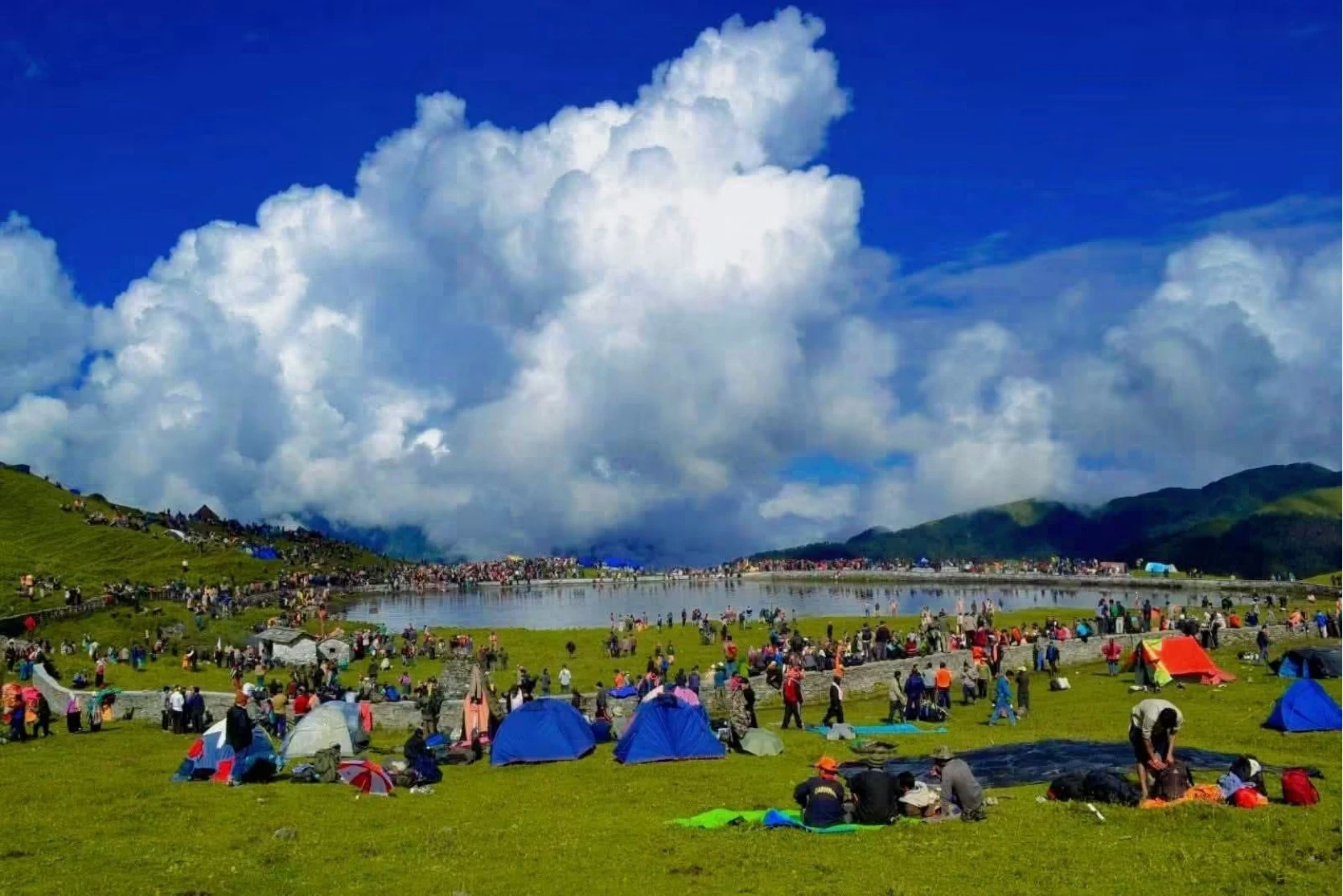
At Bedni Bugyal the scale of the place opens up. From its slopes the twin presences of Trisul and Nanda Ghunti fill the skyline. 9 It is also a place of the goddess: during the Raj Jat the procession halts here, and it is where the crowds thin as the path grows harder. 9
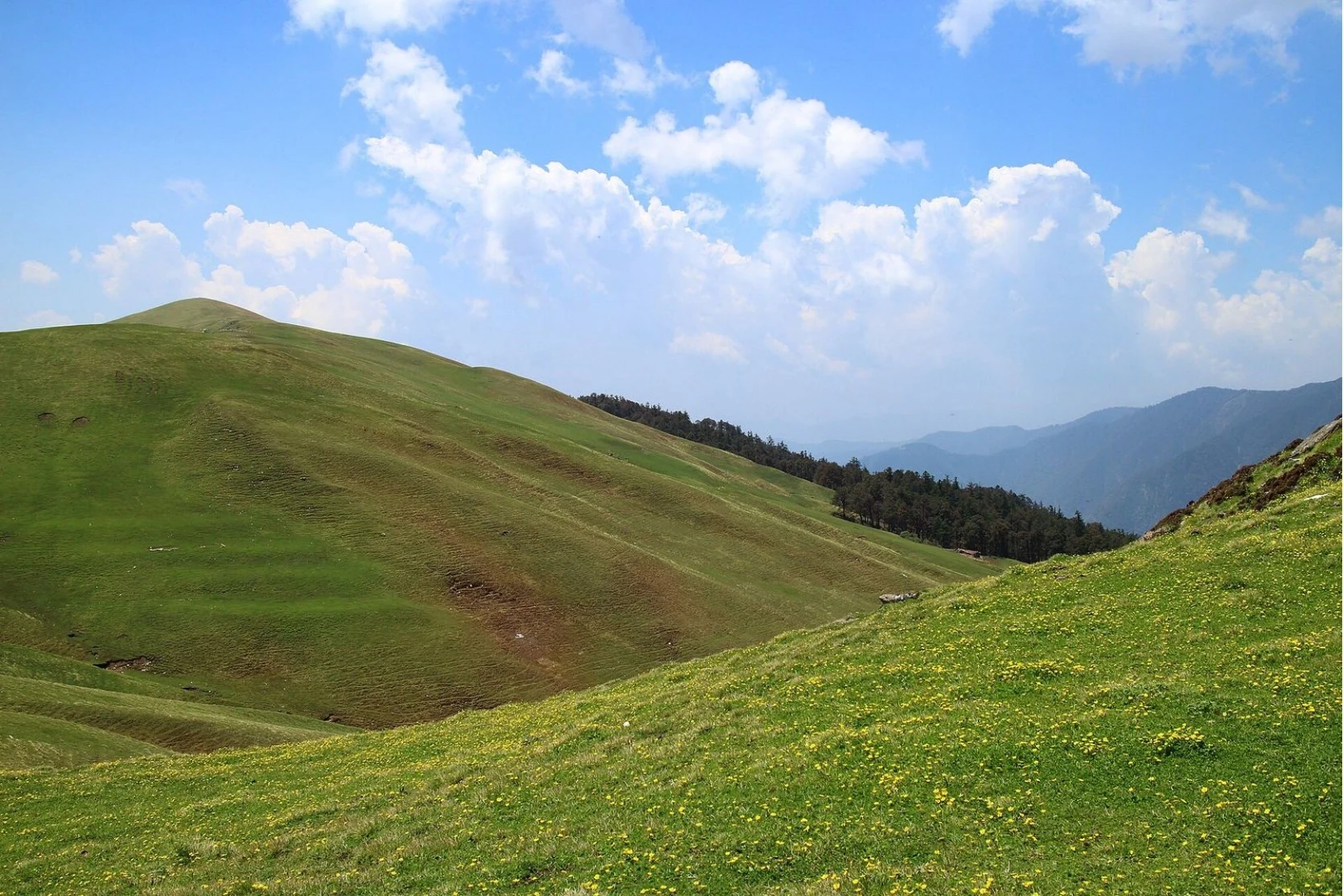
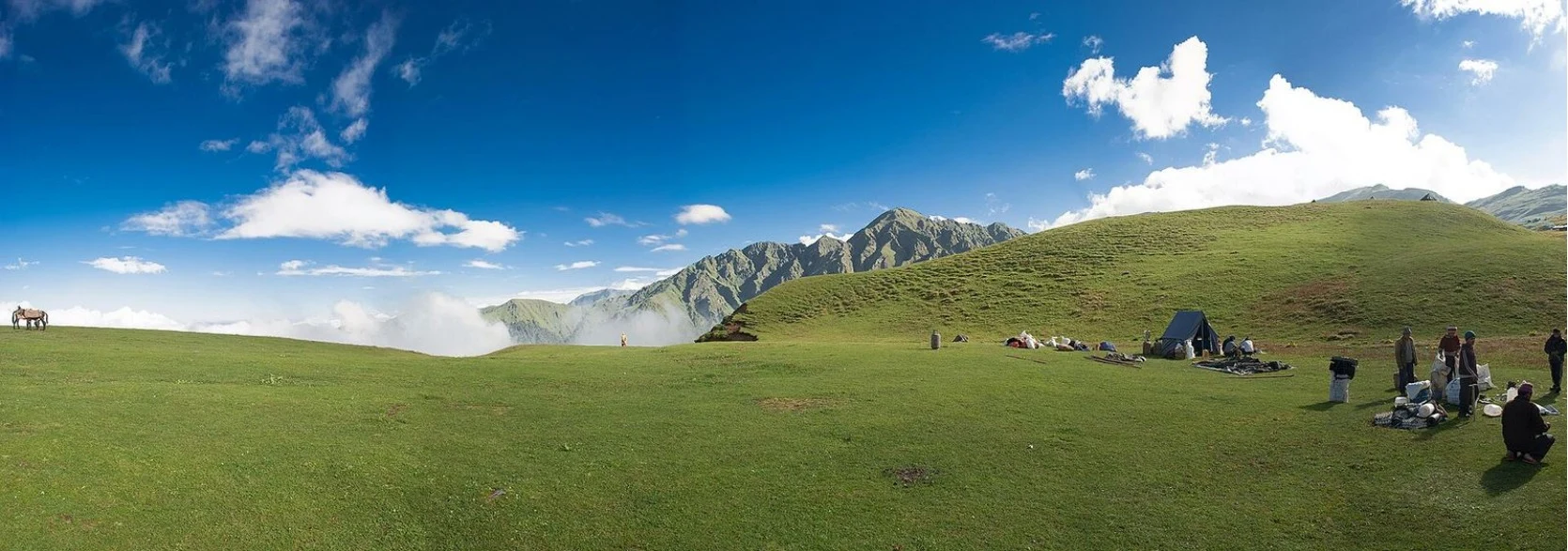
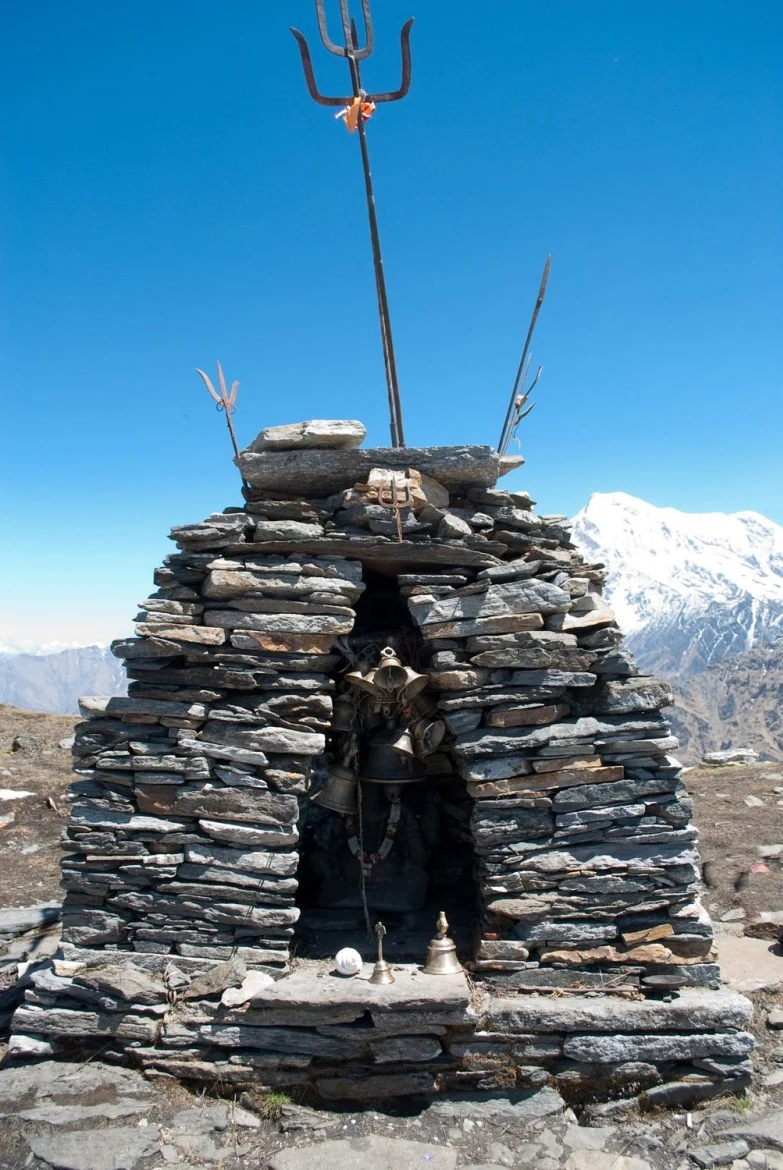
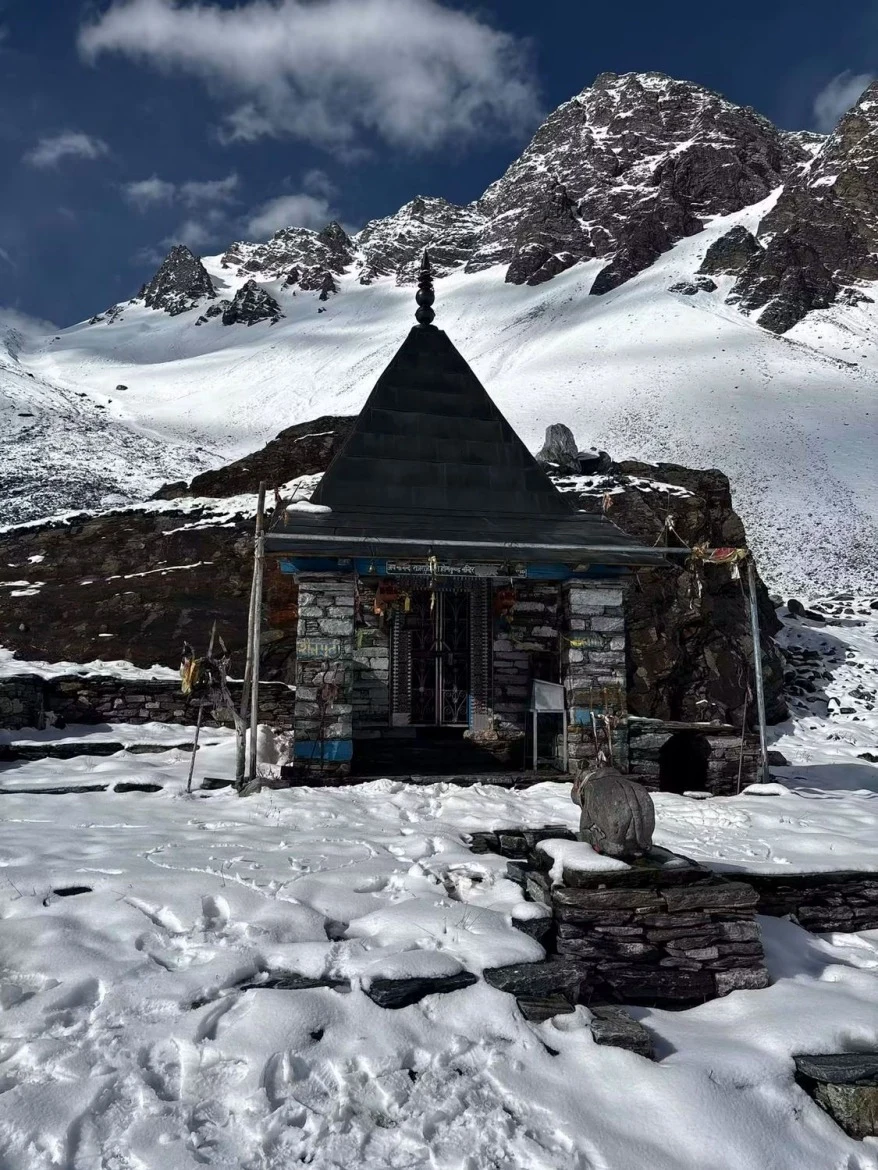
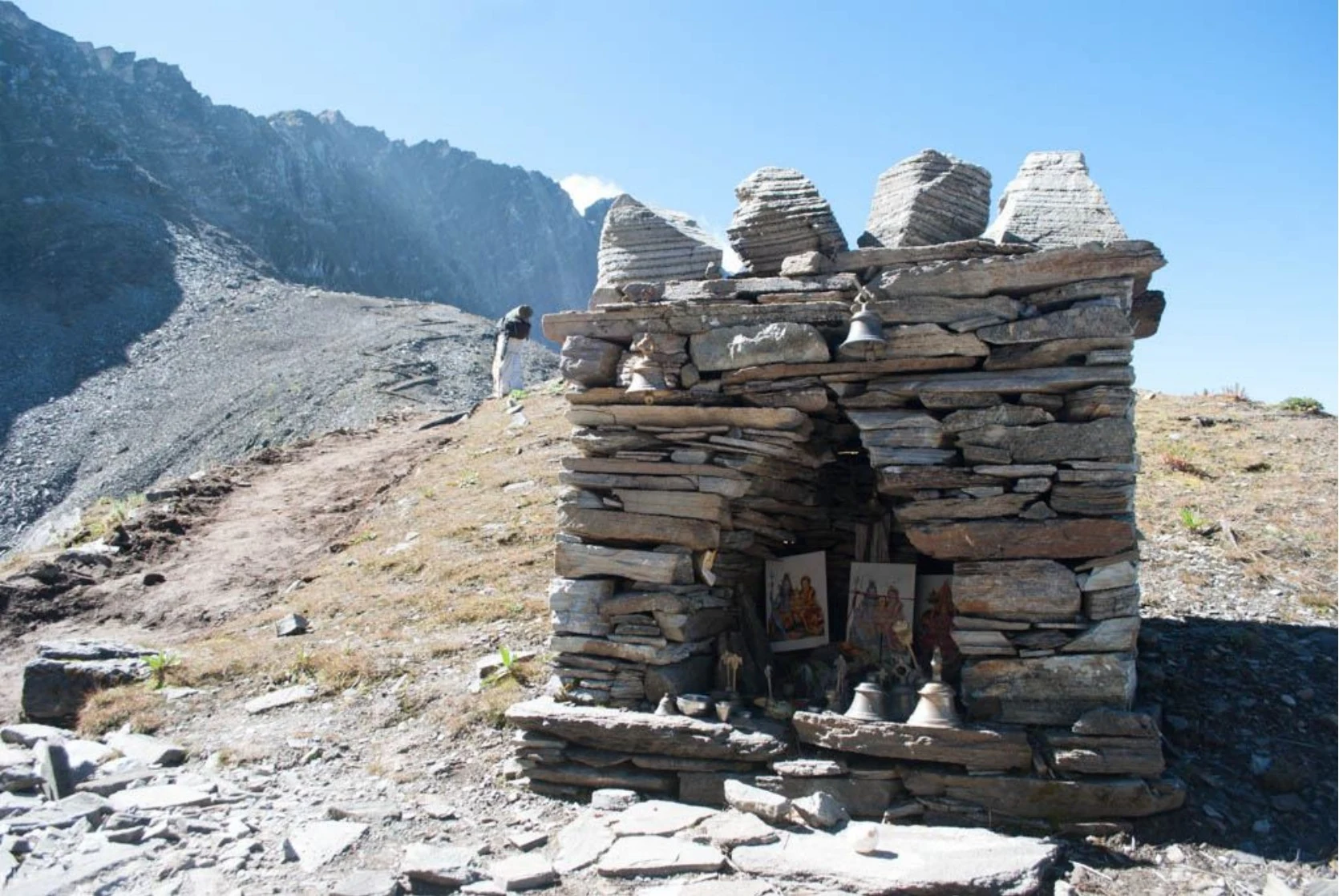
Above the meadows the land turns to rock. The trail climbs steep ridgelines past an old stone shrine to Ganesha, hung with bells and tridents, and then, at around fifteen thousand feet, crosses a pass and zigzags up through scree to the lake. 2 The shrine is known as Kalu (or Kalua) Vinayak, after its black image of Ganesha, and stands near the camp at Bhagwabasa. 10
Above the lake runs a ridge the pilgrims know as Jyumra Gali, the Path of Death, which Preston called one of the most perilous sections of what may be the longest and most dangerous pilgrimage in India. 2 Trekkers call it Junargali. Vallangi describes it as a knife-edge ridge at 5,000 metres, with the lake about 200 metres below it, and records the trekkers’ dark joke that one wrong step on the climb could add to the bones. 5 Spellings vary: in Hindi reporting on the 2026 pilgrimage it appears as Jyunragali. 11
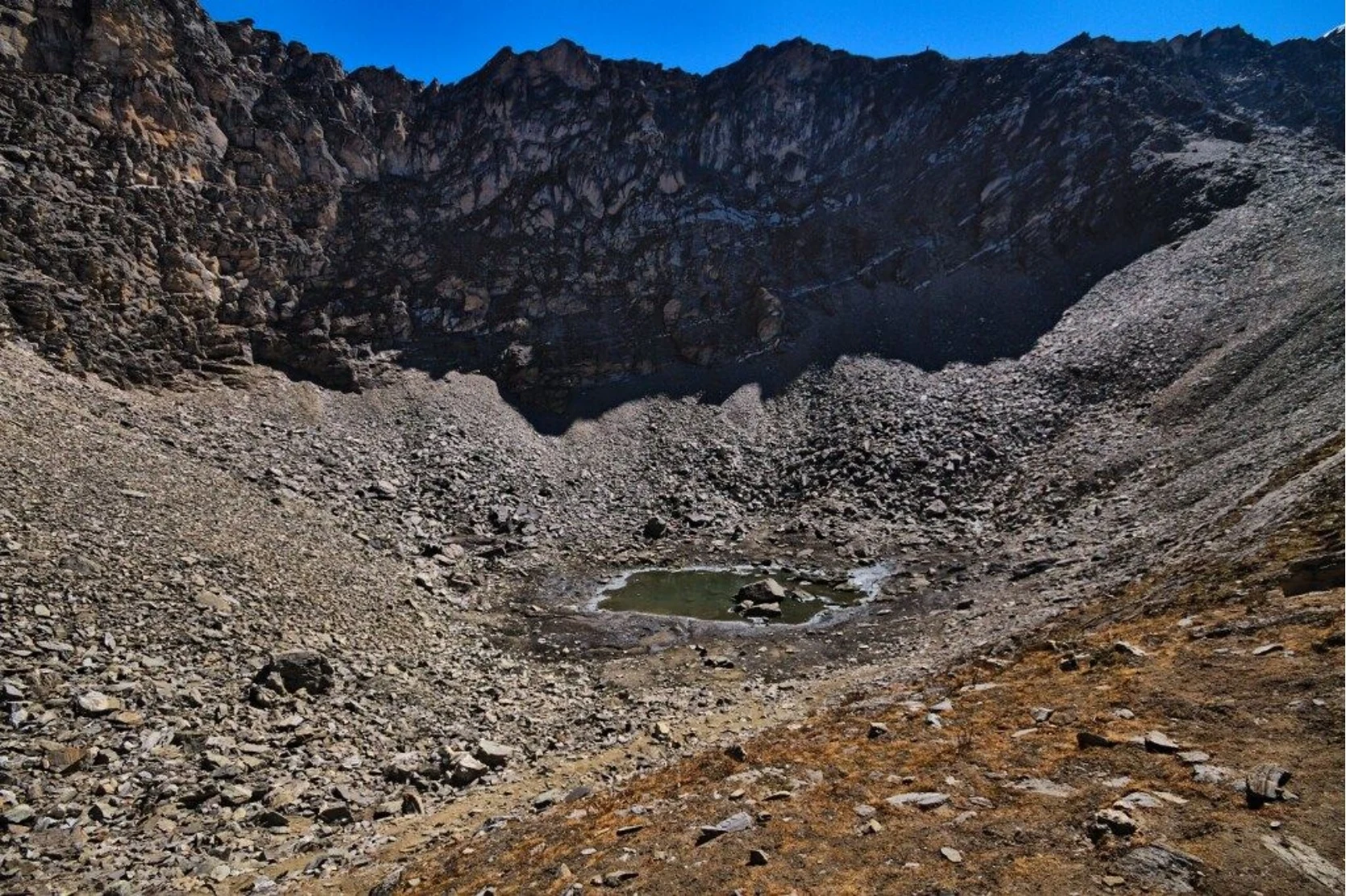
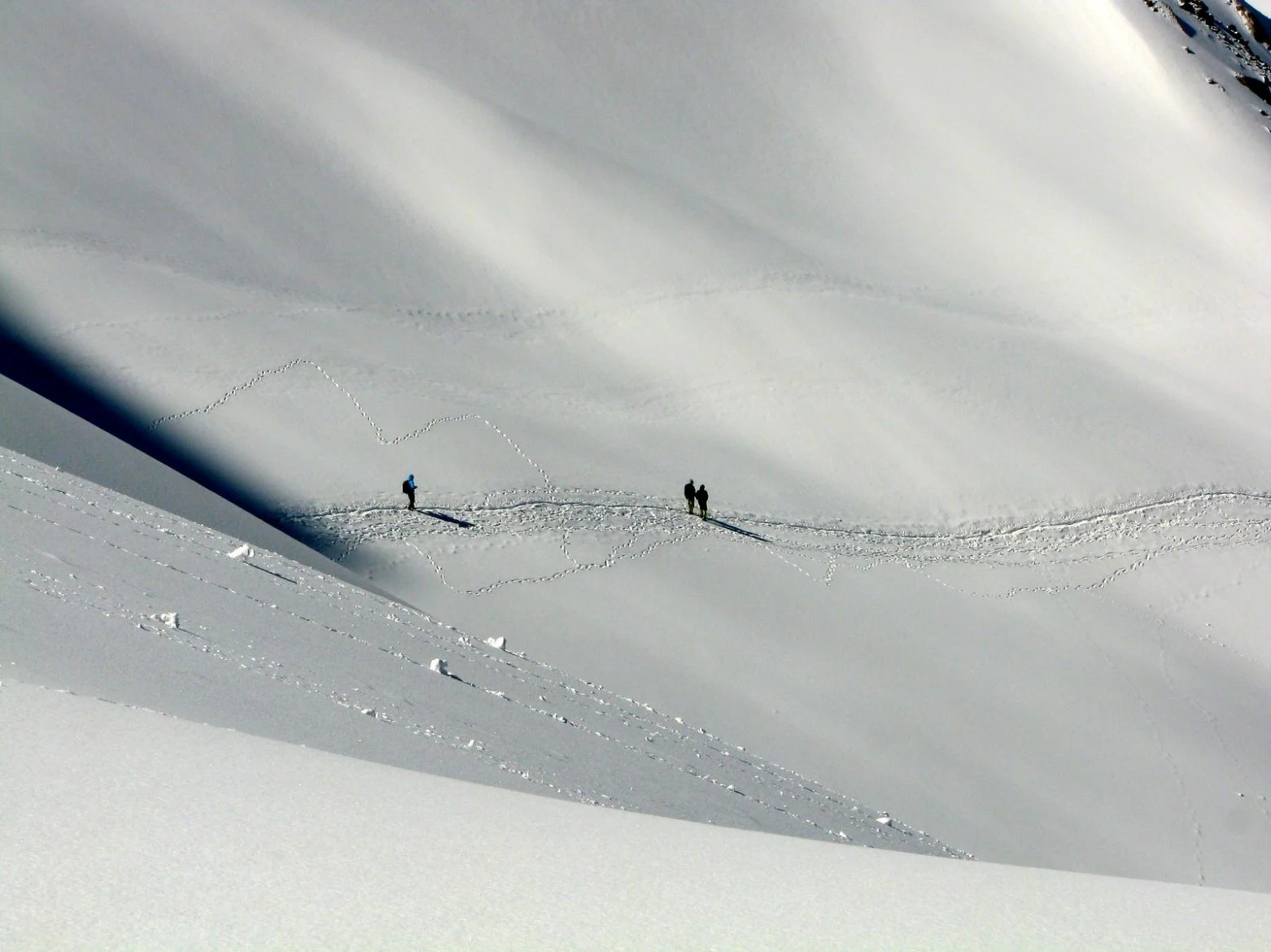
It matters that the lake is so hard to reach. The cold helps preserve the remains, while the difficult approach helps explain the obstacles to systematic investigation. Local knowledge of the bones predates their wider scientific recognition. It also shapes every theory about who the dead were. Whoever they were, they had a reason to be here.
1942: a report from the snow
The modern story begins in the middle of the Second World War, and even its first scene is told in more than one way.
In Preston’s account, a forest ranger came across hundreds of bones and skulls on the shores of the lake in the winter of 1942, some with flesh still on them; when the snow and ice melted that summer, many more were visible through the clear water. 2 BBC News describes the discoverer as a patrolling British forest ranger. 3 BBC Travel names him as H K Madhwal, an Indian forest official. 5 Down To Earth calls him a forest guard. 12 A 2023 paper on the remains lists, in its bibliography, an article by an H. R. Madhwal titled “The Mysterious Human Relics of Roopkund,” published in the Amrita Bazar Patrika on 18 September 1956. 13
We have not been able to reconcile these versions, and we will not pretend to. The accounts agree on the essentials: a forest official reported human remains at Roopkund in 1942. This was a moment of wider recognition, not necessarily the first time anyone had seen them. BBC Travel adds that the find was only announced to the public in the late 1950s. 5
The timing shaped the first reaction. With Japan at war with Britain, British officials in India at first worried that the dead might be Japanese soldiers attempting a secret invasion over the mountains. 2, 12 It was an understandable wartime fear and a short-lived one. The apparent age of the bones quickly dispelled it. 2 Down To Earth reports that the investigation concluded the corpses dated back at least a century, though nobody could say exactly when. 12
The first explanations
Once the invasion scare had passed, the bones became a puzzle, and a puzzle invites solutions. Over the next half-century almost every plausible explanation for a mass death in the mountains was proposed.
Anthropologists had known about the site since the early 1950s, according to the osteological report reprinted with the 2019 study. Two expeditions went up, one led by Professor D. N. Mujumdar of Lucknow University and one by the Anthropological Survey of India; both estimated that 600 to 800 people had died at the lake. 1 Preston describes the Survey’s effort in more detail. In 1956 the Anthropological Survey of India, in Calcutta, sponsored expeditions to the lake. A snowstorm forced the first to turn back. A second, two months later, reached the site and brought remains back for study. Early radiocarbon testing, suggested the bones were five hundred to eight hundred years old. 2 Down To Earth reports that radiocarbon tests in the 1960s pointed, vaguely, to some time between the 12th and 15th centuries CE. 12
Those early dates fed a set of rival stories. One linked the bones to General Zorawar Singh, the Dogra commander from Jammu, and to soldiers said to have lost their way and died on the journey home after the war in Tibet in 1841. 12, 3 The history behind that idea is real. Zorawar Singh led an army into western Tibet in May 1841, was defeated and killed on 12 December 1841, and many of his men died in a hasty flight through the bitter cold. 14 What the sources do not show is any route that brought those men to Roopkund, and the 1960s dates, Down To Earth notes, already counted against the theory. 12
Other scholars reached further back. The medieval dates led some historians to suggest a failed attack on the Garhwal Himalaya by Muhammad bin Tughlaq; Preston records a version involving a thirteenth-century army sent by the Sultan of Delhi to invade Tibet. 12, 2 Others imagined Tibet-bound traders who had lost their way. Some thought the lake had been a place where holy men committed ritual suicide, or an open-air cemetery, or a place where the victims of an epidemic were dumped to prevent contagion. 2, 12
These proposals varied in plausibility, but each raised questions that evidence could test. An army might leave weapons and a predominantly male group. Traders might leave goods or pack-animal remains. An epidemic might leave detectable pathogens. At a disturbed site, however, missing objects or undetected pathogens cannot conclusively rule these possibilities out. Those predictions would eventually be checked. Before that, the villages had an answer of their own.
What the villages remember
People in the villages below Roopkund had long explained the bones through songs and stories. In the version Preston retells from the anthropologist William Sax, Nanda Devi left her home to visit a distant kingdom, where the king and queen treated her discourteously. She cursed the kingdom with drought and disaster, and infested its milk and rice with maggots. To appease her, the royal couple set out on pilgrimage. 2
But the king liked his entertainments. He brought dancing courtesans and musicians, in violation of the pilgrimage’s ascetic traditions. The goddess was furious. She shoved the dancing girls down into the underworld; the pits into which they are said to have sunk can still be seen high on a mountainside. Then she sent a blizzard of hail and a whirlwind, which swept the pilgrims on the Path of Death into the lake. Their skeletons, in this telling, are a warning to those who would disrespect the goddess. 2
Other tellings give the king a name and a home. Down To Earth records King Jasdhawal of Kanauj, who undertook a pilgrimage to celebrate the birth of an heir, broke its rules with boisterous singing and dancing, and drew the wrath of the local deity Latu, who sent the hailstorm. 12 The Times of India, reporting in 2004, also placed the king in Kannauj. 15 A traditional song sung by women in the region speaks of hail “as hard as iron.” 12, 3
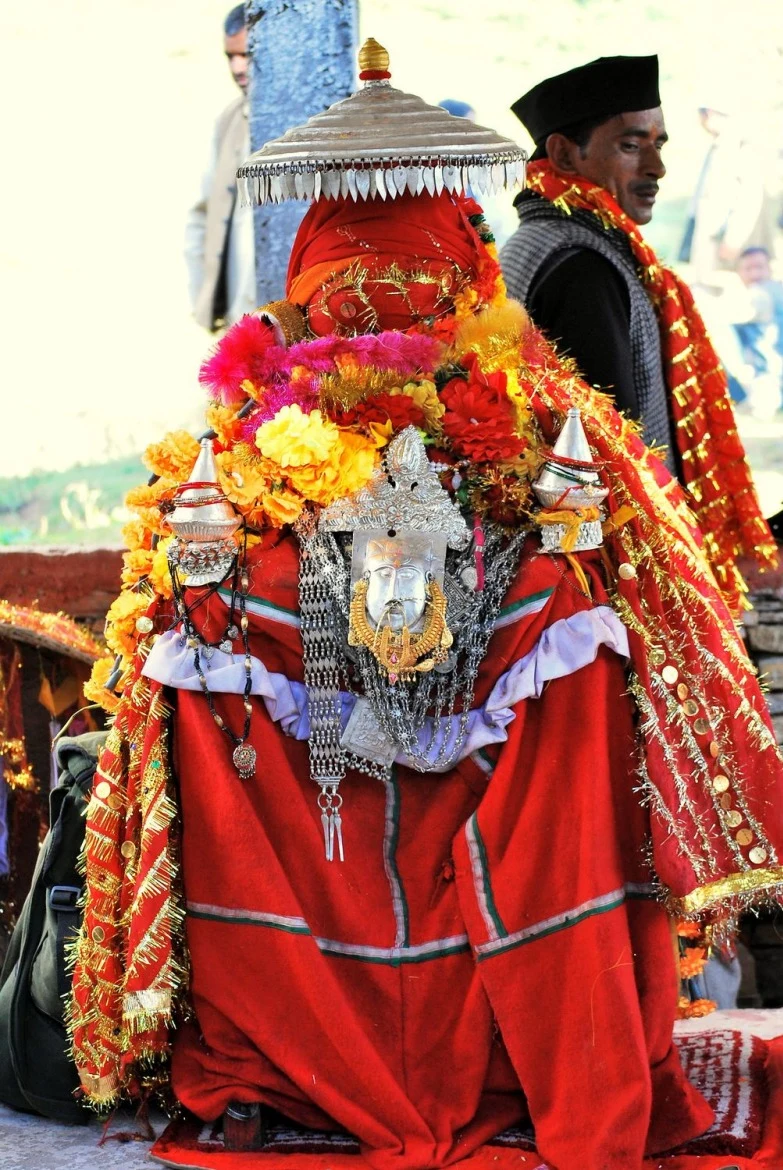
Sax, who first reached the lake as an undergraduate in the 1970s and later became a professor at Heidelberg University, spent years among the devotees of Nanda Devi. He nearly died on that first visit: a blizzard engulfed his party almost as soon as they arrived, and they stumbled around the bone-strewn cirque in whiteout calling for one another. In the late 1980s he walked the pilgrimage himself and published Mountain Goddess in 1991. 2 His point, and it is a good one, is that the women of these villages consider themselves keepers of the goddess’s memory. 2
It would be easy to treat the legend as a quaint preface to the science. That would be a mistake. The story makes specific claims: a royal party, a pilgrimage, a storm of hail, a death on the ridge. In 2004 investigators would find evidence they considered consistent with a pilgrimage and a hailstorm. That resemblance does not establish the royal party or the legend as history.
The goddess’s journey
The pilgrimage at the heart of the legend still happens. The Nanda Devi Raj Jat, the “royal journey,” symbolically retraces the goddess’s farewell journey from her parents’ home in the Garhwal Himalaya to the abode of her husband, Shiva, near Mount Kailash. 7, 9 Writing about the 2014 pilgrimage, Siddhartha Sen described how its rains are read as Nanda Devi’s tears as she leaves her father’s house; for the villagers it is like giving away a daughter. 9
Tradition attributes its beginnings to Raja Kanak Pal of Chandpur Garhi, in the 7th century CE, and the right to conduct it passed to his descendants, the Kunwars of Kansuwa. 9 Another common telling credits an earlier Garhwal king, Shalipal, with starting it, and Kanak Pal with making it grand. 16 These are traditions, not documented facts. The 2019 study is more cautious: reliable descriptions of the pilgrimage do not appear until the late 19th century, though inscriptions in nearby temples dating to between the 8th and 10th centuries suggest it may be much older. 1
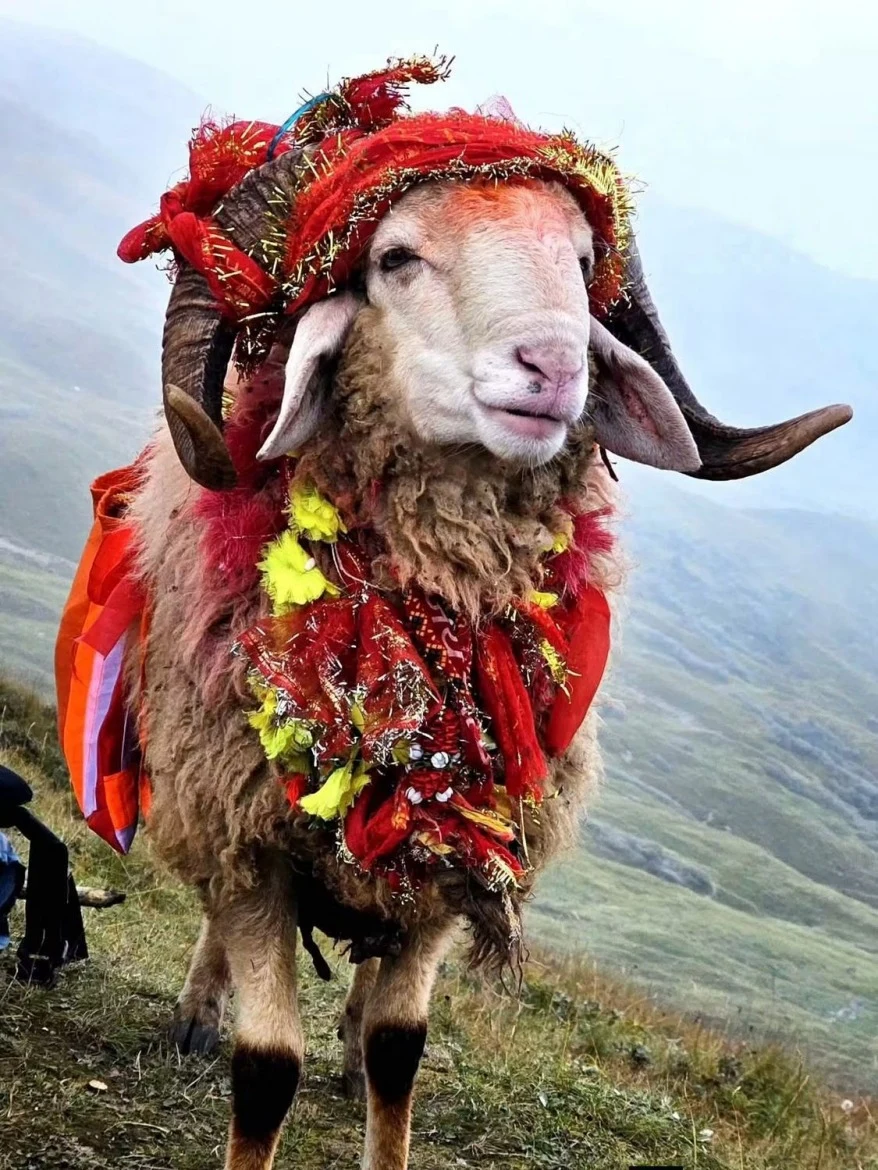
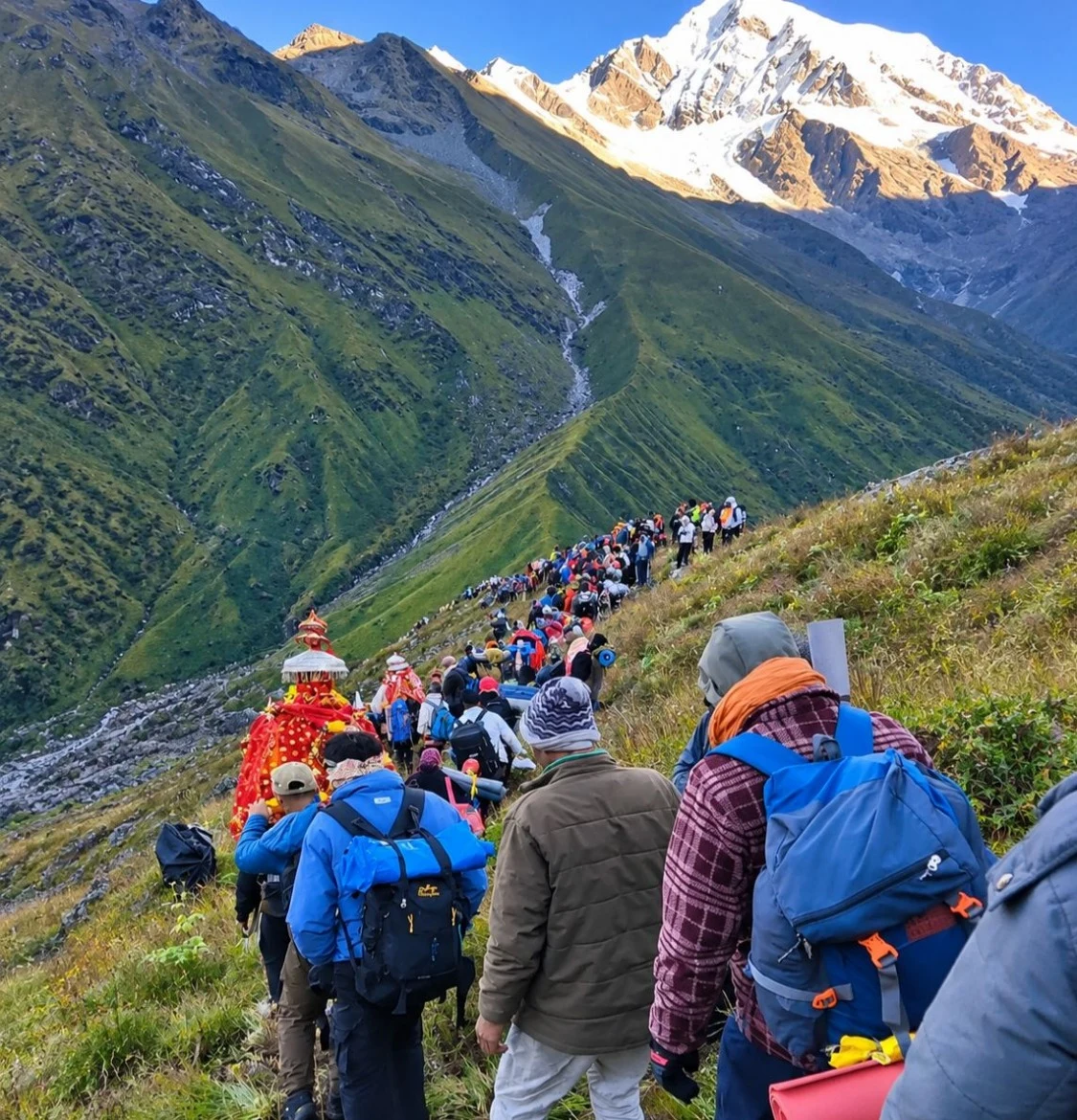
The procession travels with a four-horned ram, the chausingha khadu, and carries the goddess under a ringal chhantoli, an umbrella-like canopy made of hill bamboo. 9 From the village of Nauti it covers roughly 280 kilometres over about three weeks, much of it on foot. 7, 9 Sen counted nineteen halts between 1,200 and 4,300 metres, among them Wan, where the temple of Nanda Devi’s brother Latu opens only for the Raj Jat, then Bedni Bugyal, Roopkund and Shila Samudra, the “ocean of boulders,” before the end at Homkund. 9 There the canopies are immersed and the ram is set free; devotees believe it goes on with the goddess to Kailash. 9
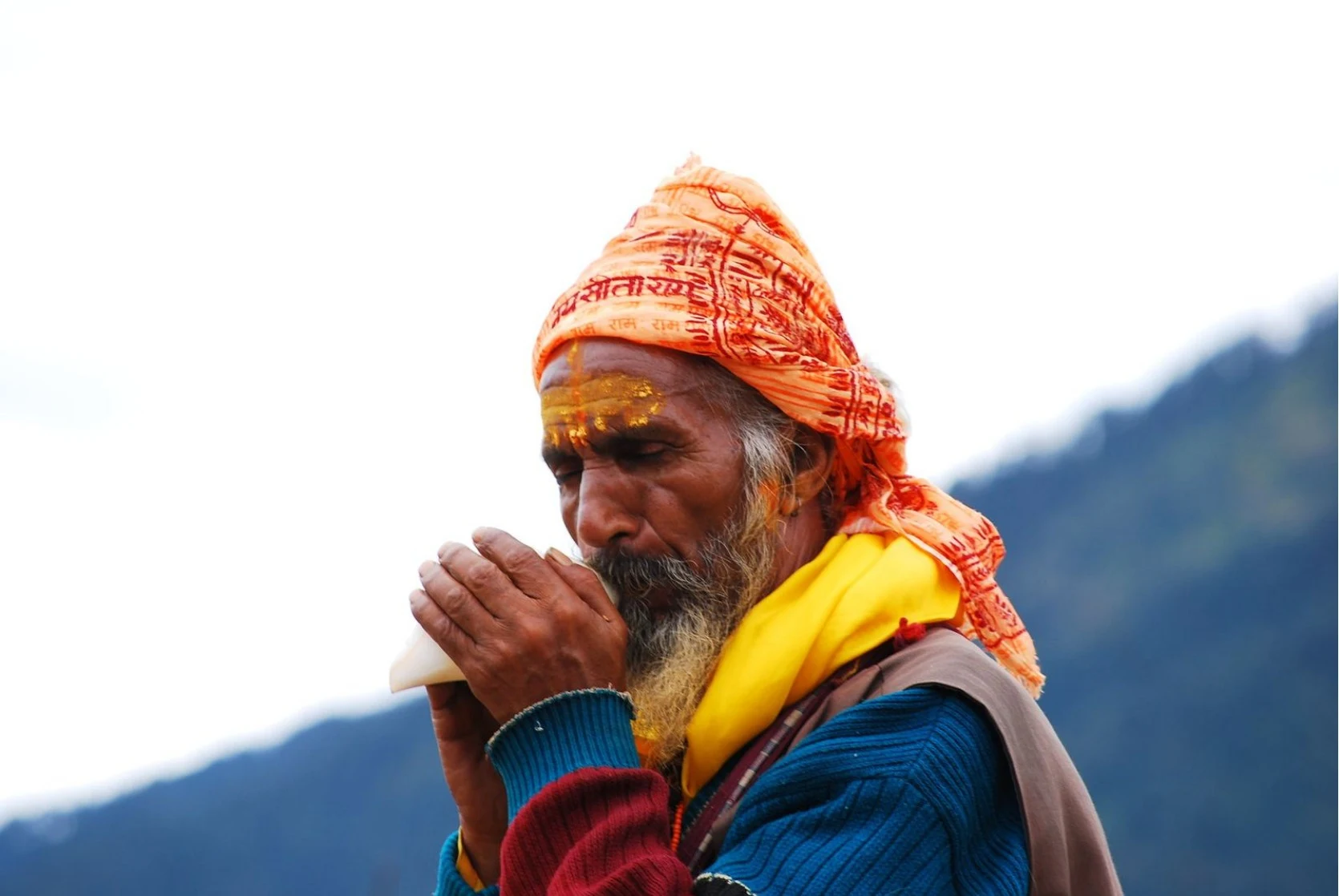
The Raj Jat has never kept perfect time. It was due in 2012, was postponed after natural disasters, could not be held in 2013 after the Kedarnath floods, and finally took place in 2014. Officials told the Times of India that it had also been delayed in 1905, 1925, 1951, 1968, 1987 and 2000, for reasons both natural and astrological. 7 The Raj Jat committee’s own records, as reported by Amar Ujala, list pilgrimages in 1843, 1863, 1886, 1905, 1925, 1951, 1968, 1987 and 2000. Not one of those gaps is exactly twelve years. After 1925 there was a gap of twenty-six years, and the 1951 pilgrimage could not be completed because of bad weather. 17 The twelve-year cycle is an ideal that the mountains have rarely allowed.
The next one was meant for 2026. In January 2026 the Raj Jat committee postponed it to 2027. Its chairman, Rakesh Kunwar, cited the risk of hailstorms, snowfall and rain in September, and infrastructure work that was not yet finished. 18, 7 Hail, of all things, was still a reason for caution on this route.
Not everyone accepted the delay. Representatives of around 484 villages in Chamoli announced their own pilgrimage, the Nanda Badi Jaat, “on similar lines.” 7 It went ahead. According to its organisers, from the Nanda Devi temple at Kurur, it ran from 5 to 23 September 2026 and drew more than 1.5 lakh (150,000) devotees. 19
Hindi press reports followed the procession over Roopkund and Jyunragali to Shila Samudra and on to the final rites at Homkund. 11, 20 Only weeks before this article was written, pilgrims were walking past the bones again.
What lay among the bones
Bones are not the only things at Roopkund, and the objects found with them gave investigators their first solid clues. When a team assembled for a National Geographic documentary examined the site, a recent landslide had exposed a cache of fresh bones and artefacts. They recovered dozens of leather slippers, pieces of parasols made of bamboo and birch bark, and bangles made of seashell and glass. 2 Down To Earth adds a ring, a spear, leather shoes and bamboo staves, and the Times of India reported iron implements. 12, 15
Just as telling was what was missing. Aside from a single iron spearhead, no weapons were found, and there was no trace of horses. There were no trade goods and no beasts of burden. 2 The cold had also preserved more than objects. “In addition to skeletons, we discovered bodies with the flesh intact, perfectly preserved in the icy ground,” said Pramod Joglekar, a bio-archaeologist at Deccan College, Pune. “We could see their hair and nails as well as pieces of clothing.” 12
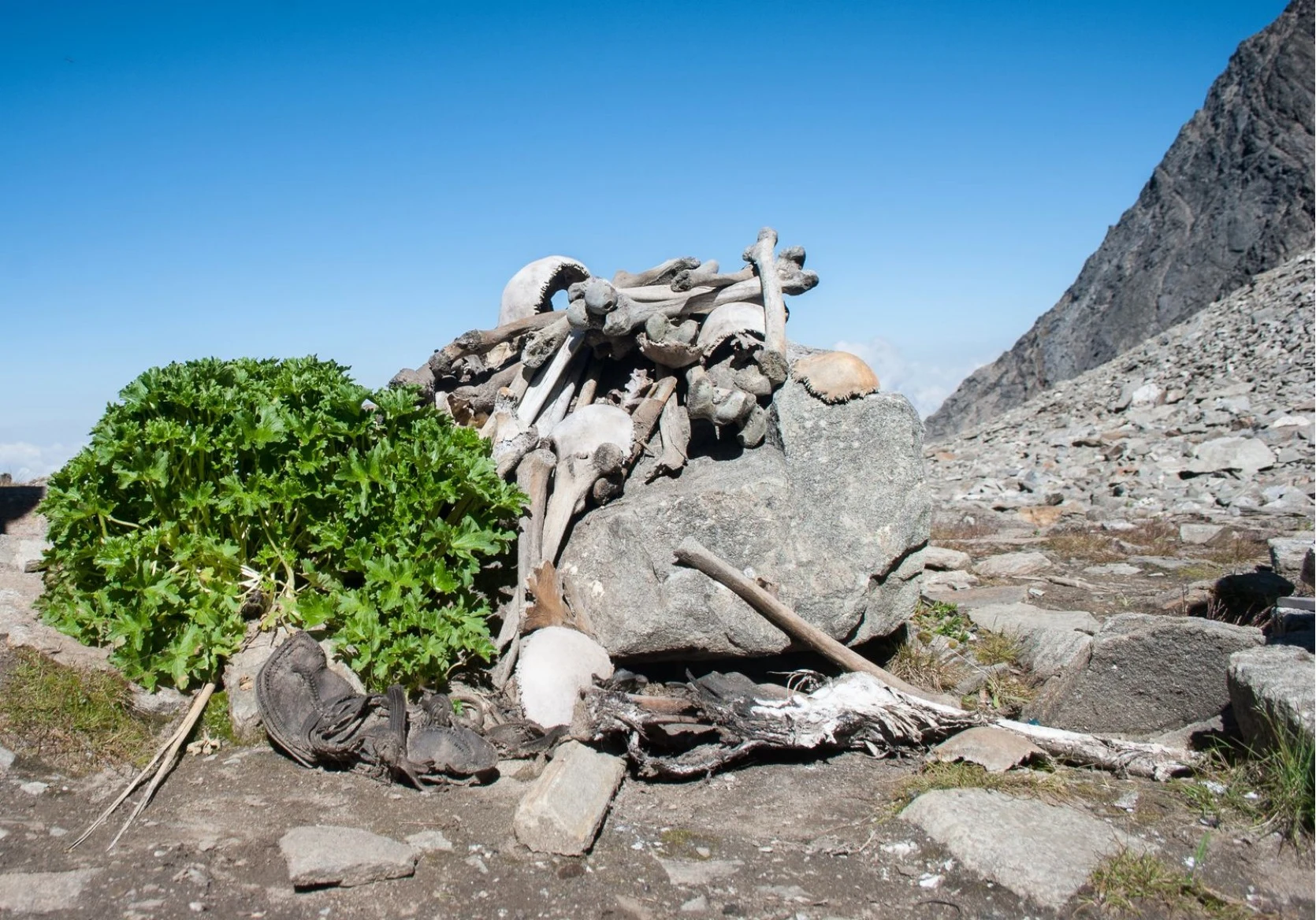
Devotees of Nanda Devi carry parasols and wear bangles on the pilgrimage. 2 Glass bangles pointed to women among the dead. 12 Slowly the objects drew a picture. These did not look like soldiers or merchants. They looked like travellers on a sacred journey.
2004: the hailstorm
The investigation that seemed to settle the question was commissioned by the National Geographic television channel. Its multidisciplinary team included physical anthropologists and archaeologists from Deccan College in Pune, among them Subhash Walimbe and Pramod Joglekar, along with William Sax and scholars from the University of Delhi. 12, 2 Veena Mushrif-Tripathy, a bioarchaeologist on the team, later recalled that when they went to collect bones in 2003, altitude sickness forced her to turn back. 2
Samples went to the Radiocarbon Accelerator Unit at Oxford University. Down To Earth reported a date of death of about 850 CE. 12 Preston describes the Oxford dates as a tight cluster in the ninth century, and quotes Tom Higham, who performed the analysis, concluding that the victims had “died instantaneously within hours of one another.” 2 The tight cluster supported a proposed common catastrophe; radiocarbon dating itself could not establish that the deaths occurred within hours.
The skulls told the rest. Walimbe’s team found short, deep cracks on several of them. “The cracks were caused not by a landslide or an avalanche but by blunt, round objects about the size of cricket balls,” he said. 12 Preston writes that three or possibly four skulls had compression fractures on the crown that had probably occurred at the time of death. 2
“The only plausible explanation for so many people sustaining such similar injuries at the same time is something that fell from the sky.”
— Subhash Walimbe, Deccan College, Pune 12
“The injuries were all to the top of the skull and not to other bones in the body, so they must have come from above,” Walimbe went on. “Our view is that death was caused by extremely large hailstones.” 12 This stretch of the Himalaya is notorious for hailstorms that destroy crops and damage property. 2 The team concluded that around the ninth century a party of pilgrims had been caught in a storm on the exposed ridge above the lake, and that over the years landslides and avalanches had carried their bodies down into the lake and its surroundings. 2
The bones seemed to show two kinds of people. Researchers described tall, rugged individuals with long heads, and others of medium height and slight build with a shallow groove across the skull. They interpreted the first as pilgrims from the plains and the second as local porters, their skulls marked by years of carrying loads with a strap around the head. 2 The osteological report, written before any genetic results, estimated four individuals at between 184 and 188 centimetres tall, very tall for any pre-modern population. 1 Geneticists at the Centre for Cellular and Molecular Biology (CCMB) in Hyderabad, led by its director Lalji Singh, analysed DNA from 31 samples of bone and muscle. Singh reported that three carried mitochondrial mutations otherwise known only from a particular group in Maharashtra, and that two matched people living in Garhwal. 12 Preston summarises the conclusion of that work as a genetic makeup typical of South Asian origin. 2
Mushrif-Tripathy later explained why the team favoured pilgrims. The scarcity of weapons weighed against a military explanation, although it could not by itself exclude violence. They found the remains of musical instruments. And old folk stories told of pilgrims on the Raj Jat. 5 Preston put the mood well. Not only did the mystery appear to be solved; the local tales of Nanda Devi’s wrath seemed to have originated in a real event. 2 When Vallangi trekked to Roopkund in 2009, a crude version of the theory was offered to trekkers as the explanation for the bones. 5
It was a good story, and parts of it may still be true. But it rested on an assumption that had not been tested. The prevailing explanation had assumed that the skeletons belonged to a single group who died in a single catastrophe. 3
2019: reading the bones themselves
The study that broke the assumption had been years in the making. In 2008 the Harvard geneticist David Reich visited the CCMB in Hyderabad and discussed a more detailed study of the Roopkund bones with Lalji Singh and with Kumarasamy Thangaraj, who had led the earlier DNA work. By the time the work began, in 2015, the team included the Reich lab, the Hyderabad laboratory, Pennsylvania State University, the Broad Institute, the Max Planck Institute for the Science of Human History and the Anthropological Survey of India, where many of the bones are kept. 2 Reich asked a graduate student, Éadaoin Harney, to take charge; she analysed the DNA, coordinated the team and wrote the paper as lead author. 2 It was published on 20 August 2019, with Harney and 27 co-authors. 1, 3
The team sampled the skeletal collection at the Anthropological Survey of India in Kolkata: 76 samples in all, 72 long bones and four teeth. 1 That detail matters. These were bones collected from the surface over earlier decades and kept in storage, not material excavated in context. The scientists did not dig at the lake. They read what was already on the shelves.
Three methods did most of the work. Each is worth understanding, because each answers a different question.
Ancient DNA: who were they? In dedicated clean rooms in Hyderabad, scientists wiped each bone with bleach, exposed it to ultraviolet light to destroy surface contamination, and drilled out powder. 1 Most of the DNA in an ancient bone is not human. It comes from the microbes that colonised the body after death, and stray DNA from anyone who handled the remains can ruin a sample. 2 Some samples were processed again at Harvard Medical School, following the ancient-DNA practice of repeating analyses in two independent laboratories. 1 Rather than read entire genomes, the team targeted about 1.2 million known positions where human DNA commonly varies, and obtained genome-wide data for 38 individuals. 1 They also determined the maternal (mitochondrial) lineage for 71 people. 1 The DNA gave each person’s genetic sex, whether any two were related, and how their ancestry compared with hundreds of present-day populations. 1, 2
Radiocarbon: when did they die? Living things take in carbon, including a tiny fraction of radioactive carbon-14, until they die; after that the carbon-14 decays at a known rate. Accelerator mass spectrometry measures the remaining carbon-14; calibration against a reference curve then estimates calendar-date ranges. These ranges cannot resolve deaths to a particular day or hour. The collagen was prepared at Penn State’s radiocarbon facility and measured at the University of California, Irvine, using the same bone powder that had gone into the genetic analysis, so that each date belonged to a known genome. 1, 2 It worked for 37 people. 1
Stable isotopes: what did they eat? Two important photosynthetic pathways for interpreting these diets are C3 and C4. Wheat, barley and rice are C3 plants; millets are C4. The difference survives as a ratio of carbon isotopes in the bones of the people who ate them. Femur collagen reflects diet over roughly the last ten to twenty years of life. 1, 2 The team measured 45 individuals. 1
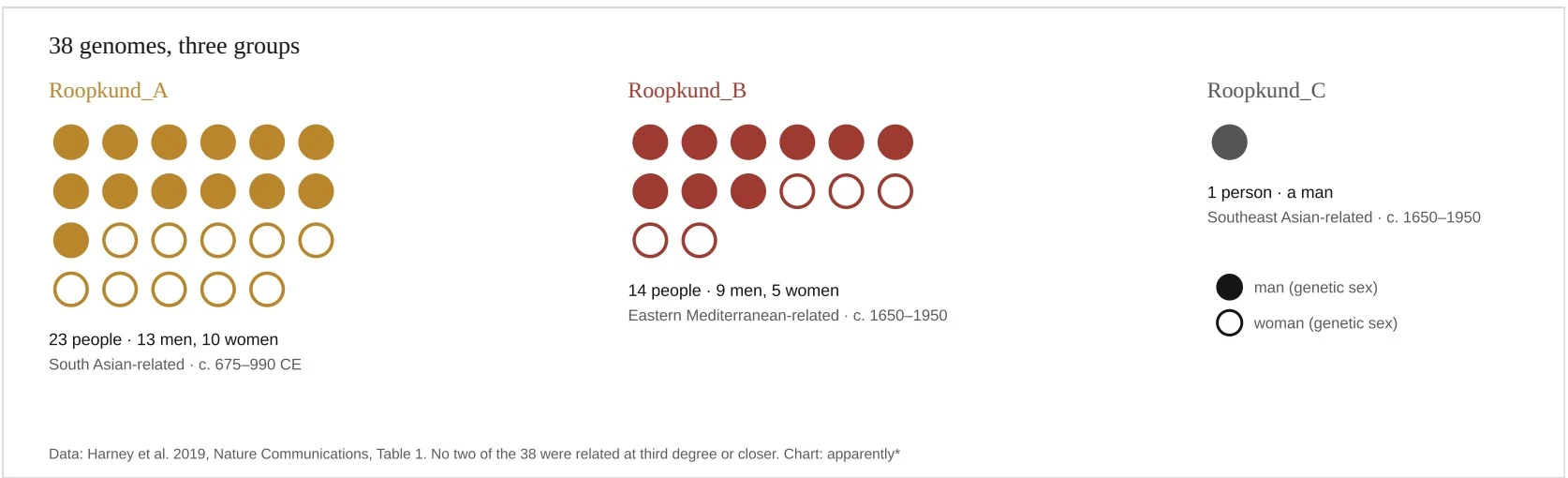
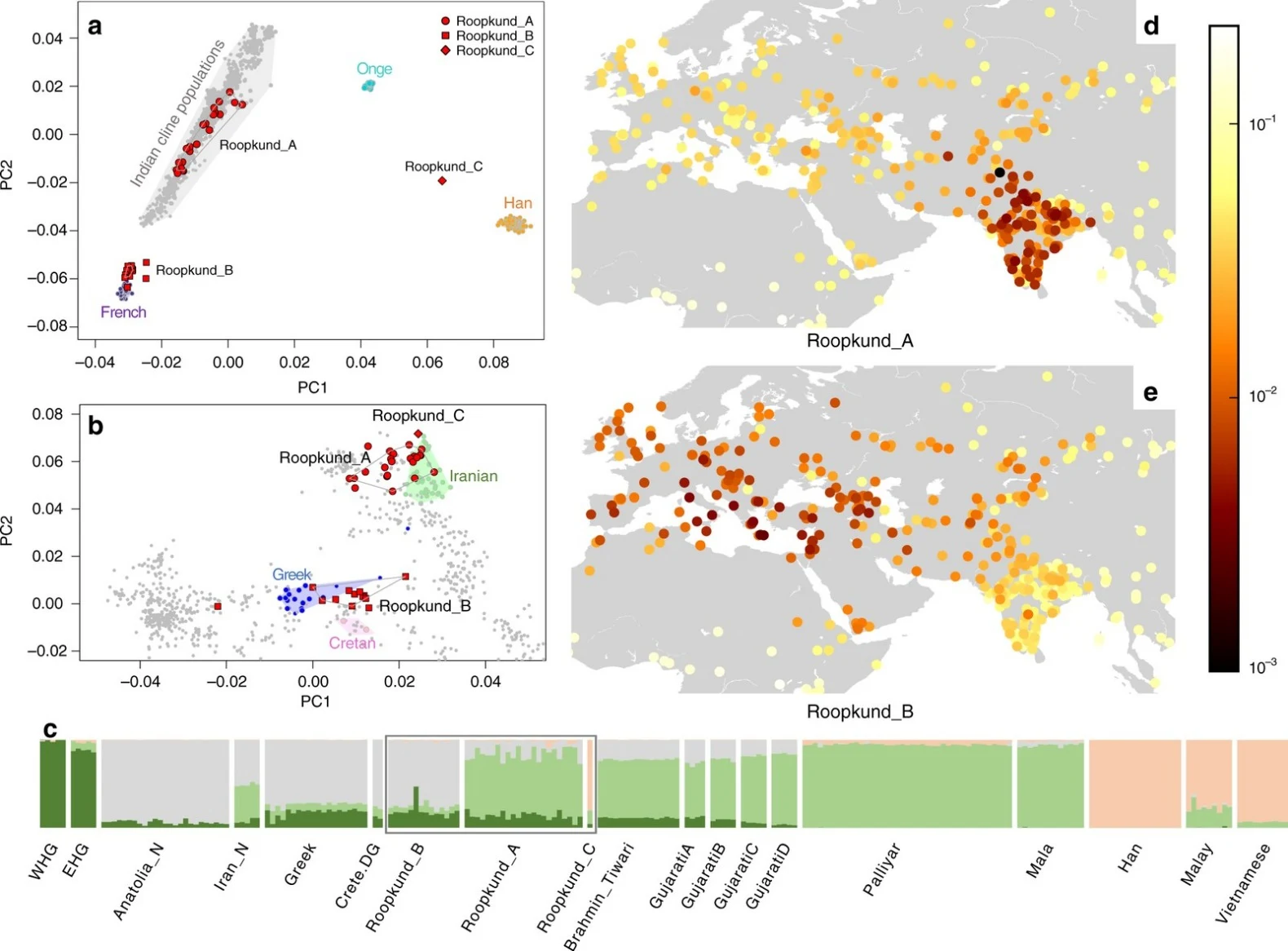
The first finding was that they were not one people. On a principal component analysis, a standard statistical map of genetic variation, the 38 individuals fell into three distinct clusters, which the paper labelled Roopkund_A, Roopkund_B and Roopkund_C. 1 By the middle of 2017 this was already clear to the team. 2
Twenty-three people, the A group, had ancestry typical of South Asia. But they did not form a tight cluster. The paper found that they could not be modelled as a single group and derived instead from a diversity of groups. 1 Harney told the BBC that some had ancestry more common in the north of the subcontinent and others ancestry more common further south. 3 There was even a weakly significant difference between the men and women in the group, suggesting that they were drawn from different mixtures of populations. 1
Fourteen people, the B group, had ancestry closely related to present-day eastern Mediterranean populations rather than the South Asian comparison groups. On a finer analysis of West Eurasian populations they sat close to people from mainland Greece and Crete. 1 Statistically, the only present-day population with which they could form a genetic clade was Crete. The paper is careful: this “by no means” implies they came from Crete itself, only that they or their recent ancestors came from somewhere nearby. 1 Reich was blunter. “It would be a mistake to say these people were specifically from Crete,” he said. “A very careful analysis showed they don’t match perfectly. They are clearly a population of the Aegean area.” 2
“We have sampled three hundred different groups in India, and there’s nothing there even close to Roopkund B.”
— David Reich, Harvard Medical School 2
One person, the C group, had ancestry typical of Southeast Asia, which the team could model as about 82 per cent Malay-related and 18 per cent Vietnamese-related. 1 None of the groups showed any special genetic affinity with present-day Himalayan people. The team checked this directly: it genotyped 88 people from the highlands of Ladakh and 16 people from four villages close to the lake, Dewal, Baimaru, Wan and Tiirpak. The villagers of Wan, where the Raj Jat halts at the temple of Latu, were no closer to Roopkund_A than other present-day Indian groups were, and no closer to Roopkund_B than Cretans were. 1, 9 The comparisons found no special genetic affinity with the sampled nearby communities. They do not establish that none of the ancient individuals could have contributed ancestry to anyone living in the region today.
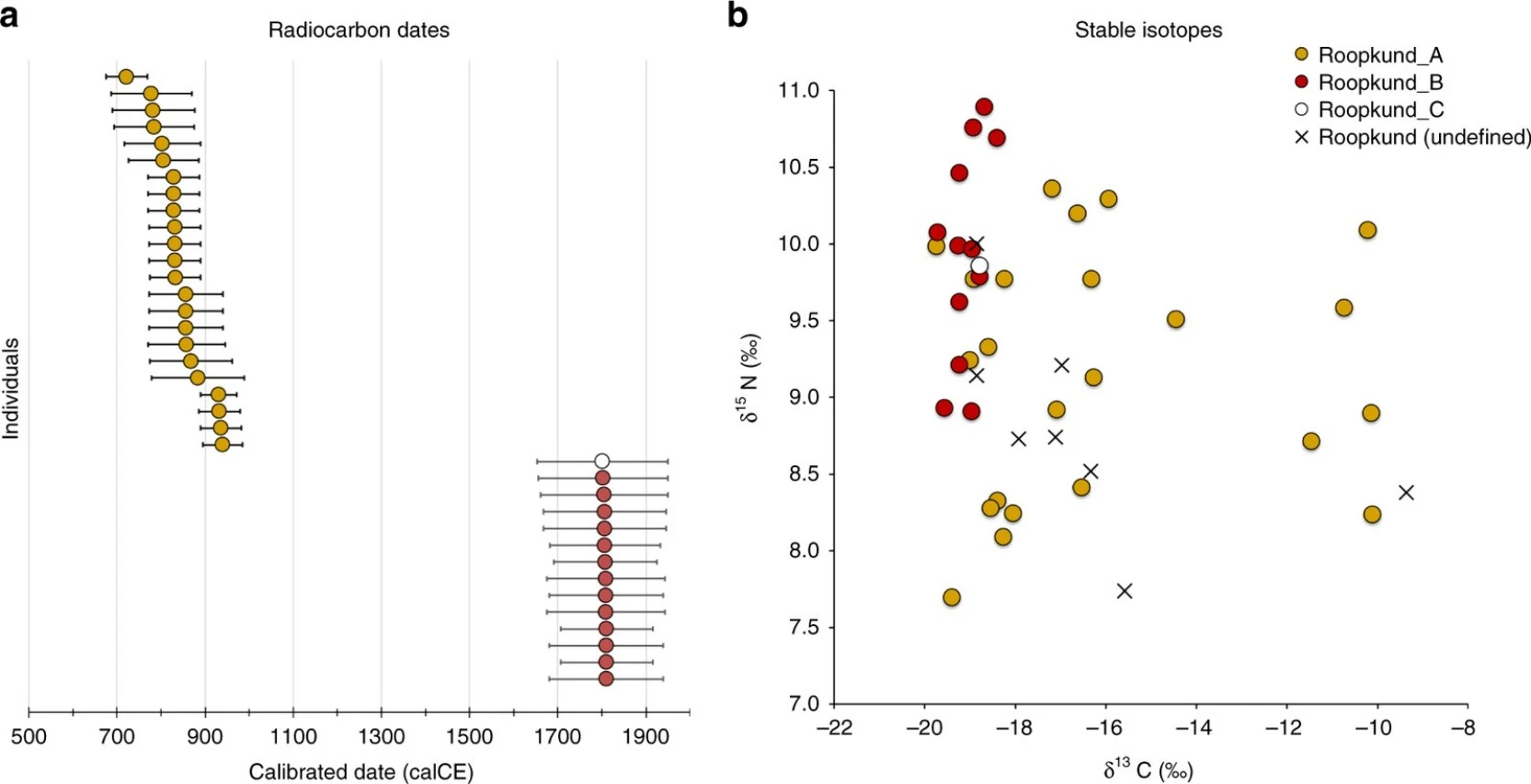
The second finding was that they did not die together. The radiocarbon dates divided cleanly along the genetic lines. The calibrated dates for the A group ran from the 7th to the 10th centuries CE. The B group dated from the 17th to the 20th centuries, and the single C individual to the same late period. 1 The two main groups were separated by roughly a thousand years. 1
Even the A group may not have died at once. Some of its date ranges do not overlap at all: one individual dates to 675–769 CE and another to 894–985 CE. 1 Preston, summarising the results, writes that the A group probably died in three or possibly four incidents between 700 and 950 CE. 2 By contrast, the dates for the 13 B individuals and the C individual all overlap, consistent with, but not proof of, a single event. 1 Radiocarbon is hard to pin down for the period between 1650 and 1950, so a proposed shared event cannot be dated precisely within that span, though the probabilities lean slightly towards the 18th century. 2
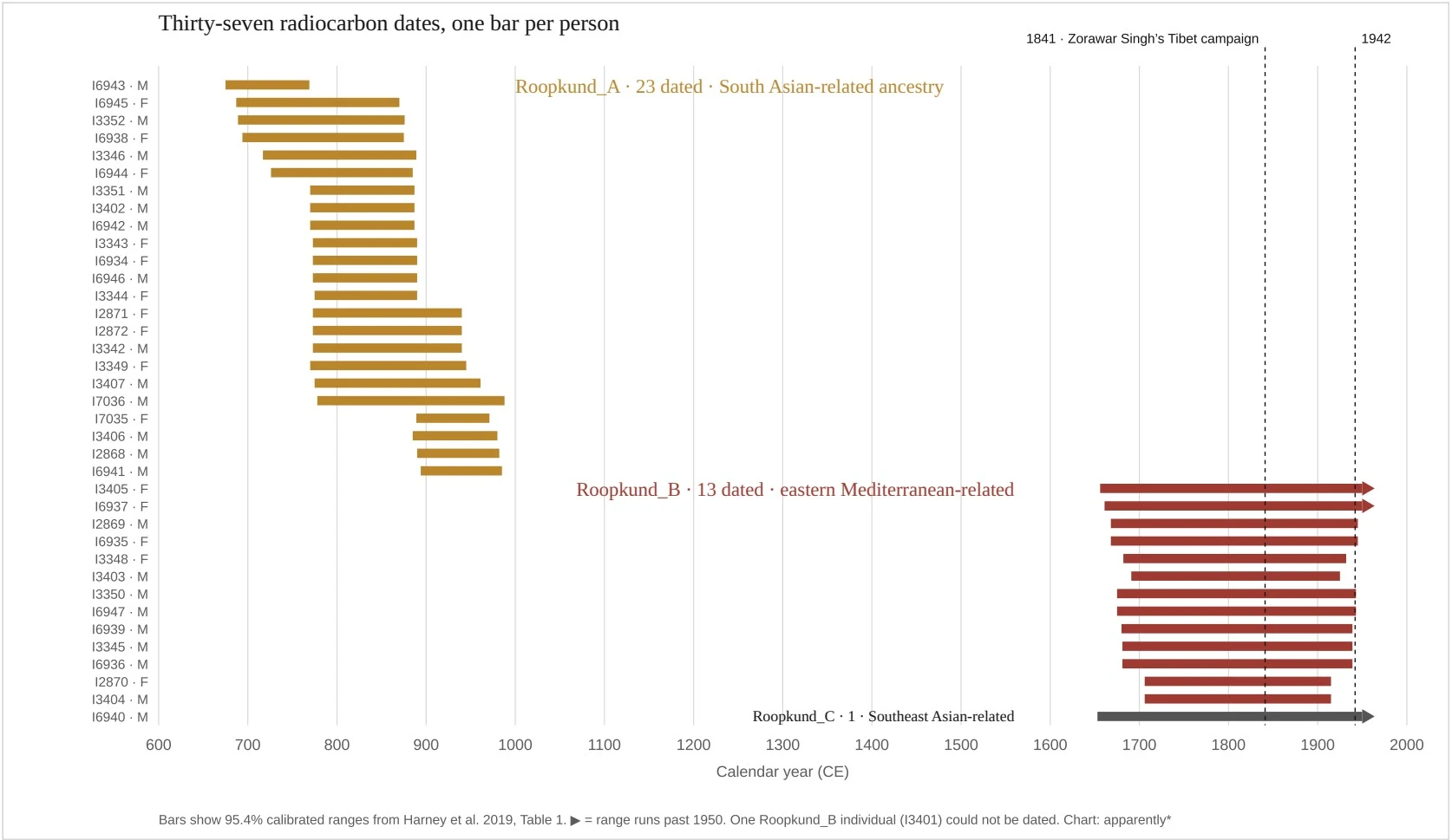
The result was so unexpected that Reich and Harney at first suspected a typo, or contamination. 2 It was neither. Harney put the consequence plainly: “It upends any explanations that involved a single catastrophic event that lead to their deaths.” 3
“It is still not clear what happened at Roopkund Lake, but we can now be certain that the deaths of these individuals cannot be explained by a single event.”
— Éadaoin Harney, lead author, to BBC News 3
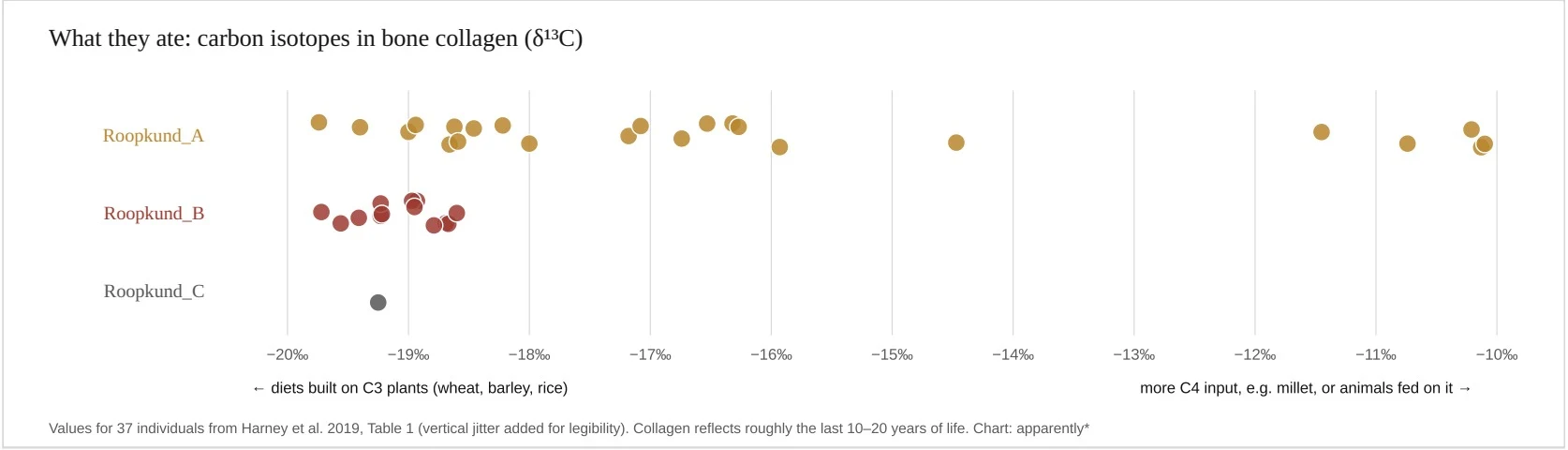
The third finding was that they ate differently. All the B individuals and the C individual had carbon values between −19.7‰ and −18.2‰, a signature of diets built on C3 plants such as wheat, barley and rice, or on animals foddered on them. The A group ranged much more widely. Some relied on C3 plants; others had a mixed diet with C4 plants such as millet, or ate animals fed on millet, a practice documented in South Asia. The difference between the two main groups was highly significant statistically. 1 Diet over a decade is not ancestry over generations, so this is an independent line of evidence. It points the same way.
Several old theories fell away. Among the 38, genetic males numbered 23 and females 15. 1 A proportion that close is, the authors wrote, difficult to reconcile with a military expedition, which also tells against Zorawar Singh’s soldiers. 1 There is a simpler problem too. The B group’s date range does include 1841, but a Dogra army from Jammu would be expected to carry South Asian ancestry, not eastern Mediterranean ancestry. That last step is our inference, not the paper’s. No two of the 38 were related at the third degree or closer, which means the sample contains no detected close relatives; it does not exclude family travel among the wider, unsampled population. 1 The team found no DNA from bacterial pathogens. That gives no support to the idea of an epidemic, though the authors caution that pathogen DNA may simply have been too scarce to detect in long-bone powder. 1
The paper also reprinted, in edited form, Walimbe’s osteological report from the documentary years, presented as an edited report on a different set of bones from those used for the genetic analysis. It identifies three individuals with unhealed compression fractures and suggests they could have happened in a violent hailstorm, while recognising that other scenarios are plausible. It also noted both very robust, tall individuals and more gracile ones, and proposed at least two distinct groups, which is consistent with the genetics. 1
What, then, did the authors conclude? For the A group, they called a mass death during a pilgrimage a plausible explanation for at least some of the individuals. 1 For the B group, they considered and rejected descent from Indo-Greek populations established after the time of Alexander the Great. Such a group would be expected to show mixture with South Asians or signs of inbreeding, and Roopkund_B showed neither. 1 The authors proposed that these men and women had come from the eastern Mediterranean during the Ottoman period, perhaps from an inland area. Their genetic affinities and largely terrestrial diets support that hypothesis, but neither establishes a birthplace, nationality, religion or travel route. 1 Why they came, the paper says, “is a mystery.” 1
Timeline
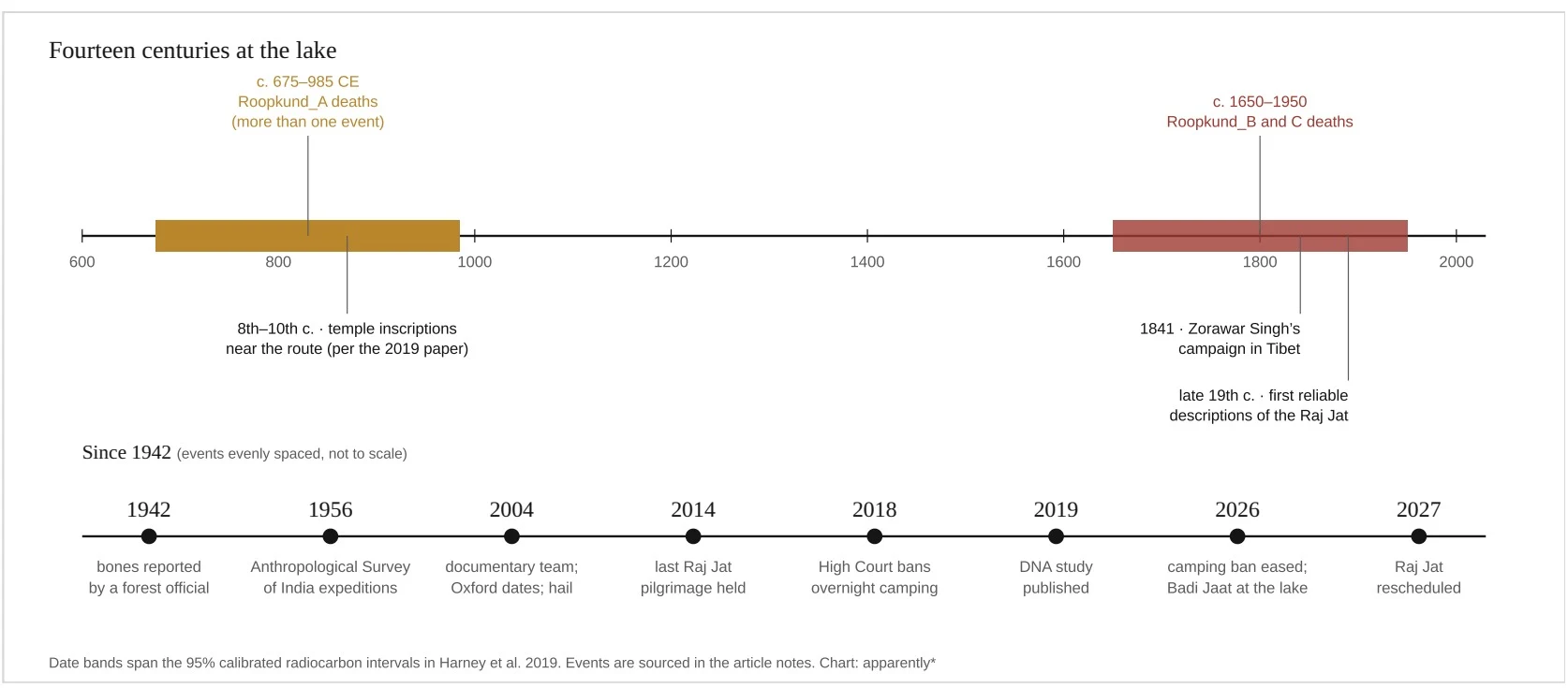
c. 675–985 CE Radiocarbon ranges for the 23 South Asian-related individuals, probably in more than one event. 1, 2
8th–10th c. Inscriptions in temples near the route hint that the pilgrimage is old. 1
c. 1650–1950 Dates for 13 of the 14 eastern Mediterranean-related people and one Southeast Asian-related man, possibly in a single event. 1, 2
1841 Zorawar Singh’s army is defeated in western Tibet; it was later linked to the bones, a link the evidence does not support. 14, 12, 1
Late 19th c. First reliable descriptions of the Raj Jat. 1
1942 A forest official reports hundreds of skeletons; officials briefly fear Japanese soldiers. 2, 5
1950s Expeditions from Lucknow University and the Anthropological Survey of India estimate 600–800 dead 1; in 1956 early carbon dates suggest 500–800 years. 2
2003–2004 A team assembled for National Geographic collects remains; Oxford dates cluster in the 9th century; the hailstorm theory. 2, 12
2014 The Raj Jat is held after postponements in 2012 and 2013. 7
2015 Work begins on the genetic study. 2
Aug 2018 The Uttarakhand High Court bans overnight stays in the bugyals, effectively closing the classic trek. 8, 21
5
Aug 2019 The study is published in Nature Communications on 20 August. 1
Jan 2026 The Raj Jat is postponed to 2027; villages announce a Badi Jaat instead. 18, 7
Jul 2026 The Supreme Court sets aside the night-stay ban and visitor cap; other protections remain. 22, 23
Sep 2026 The Nanda Badi Jaat crosses Roopkund to Homkund, 5–23 September. 19, 11
The reaction
The response was a mixture of wonder and scepticism, and some of the sharpest scepticism came from people who knew the place best.
William Sax was incredulous. He felt certain that if a large party of travellers, especially foreigners, had died at Roopkund in recent centuries, the women who keep the goddess’s songs would remember it. “I never heard a word, not a hint of a story, no folktale or anything,” he told Preston. “And there’s absolutely no reason to be up there if they weren’t on the pilgrimage.” He suggested a simpler explanation: the B bones might have been mixed up in storage, and the researchers had taken their provenance on trust, since they did not collect the bones themselves. 2
“This isn’t just a story about bones. It’s also a story about human beings and religious devotion.”
— William Sax, Heidelberg University 2
Historians consulted by Preston, specialists in South Asian and Greek history and in Himalayan mountaineering, said they knew of no evidence of a large group of unrelated eastern Mediterranean men and women travelling in the Himalaya before 1950. 2 Harney said the team had hoped that after publication “someone would come forward with information that would help us determine what might have happened at Roopkund—some historian or a person with knowledge of a group of European travellers who vanished in the Himalayas around that time.” 2
Some of the scientists were the most cautious of all. Mushrif-Tripathy, who worked on both the 2004 investigation and the 2019 paper, told BBC Travel how thin the direct evidence for hail is. “There are hardly six to seven skulls [with] trauma related to hail,” she said. 5 She thought hail was probably involved in one mass death, but that most people had likely just died of exposure. 2
“According to me, the mystery is not at all solved. We have more questions than answers.”
— Veena Mushrif-Tripathy, co-author of the 2019 study, to BBC Travel 5
Ayushi Nayak, of the Max Planck Institute, who did the isotope work, framed the open questions precisely: why the group closest in ancestry to modern eastern Mediterranean people came to Roopkund, whether they were European travellers or locals with eastern Mediterranean ancestry, and whether other sites in the region hold similar accumulations of remains. 5 She also noted that Hindu pilgrims sometimes go barefoot and thinly clothed to Himalayan shrines as a spiritual challenge. 2 In a sudden blizzard, that devotion can be fatal.
Who were the people of group B?
Once the data were public, people began to offer explanations for the most puzzling group. Each deserves a fair hearing, and each runs into evidence.
A mix-up in storage. Sax’s suggestion was the most deflationary. Reich and Fiedel argued against a random mix-up because the B group is coherent in date, diet and ancestry. That coherence makes an arbitrary jumble less convincing, but does not independently establish the collection history of every bone. And even if the bones had been mislabelled, that would only create another mystery: how a set of 18th-century Aegean bones came to be in a store in India. 2
Armenian traders. Stuart Fiedel, a recently retired archaeologist, argued that the B group’s maternal and paternal lineages are rare in the Greek islands but relatively common among Armenians and other peoples of the Caucasus. Armenians did trade widely in Tibet, India and Nepal in the 17th and 18th centuries, in pearls, amber and musk. Fiedel went further, speculating that the travellers had been robbed and killed by Thuggees, since nothing of value was found on them. 2 Reich rejected the genetic argument: the B group’s full DNA, he wrote, was “extremely different from Armenians both modern and ancient.” Scholars increasingly regard British accounts of the Thuggees as inaccurate or embellished. 2
Pilgrims after all. It would be surprising, the paper notes, for a large party from the eastern Mediterranean, where Hindu practice has not been common, to join a Hindu pilgrimage; that would be more plausible for someone like the Southeast Asian individual. 1 Fiedel put it more sharply. There is no documented presence of substantial Greek communities in northern India at the time, he said, and no record of Europeans converting to Hinduism or Buddhism then. 2
A resident community. Nayak’s question remains open: were these people travellers at all, or locals with eastern Mediterranean ancestry? 5 The paper’s genetics argue against a long-isolated enclave, which would show inbreeding or mixing, and the isotope evidence is consistent with the proposed origin. C3-based diets also occur in South Asia, however, so diet alone cannot locate a person’s home. 1, 2 But no historical source has yet been found to fill the gap.
The authors’ own suggestion is the most practical. Because the B and C individuals died only in the last few centuries, archives may hold reports of large foreign travelling parties dying in the region. 1 That is the kind of evidence that could, one day, give these people a name.
After 2019
The 2019 study remains the central genetic and dating evidence discussed here. Two later publications address health and diet, rather than resolving the identity of group B. This is a review of the sources below, not a claim to an exhaustive survey of every publication through October 2026.
In 2023, the archaeologist Alka Barthwal published a note on 27 cranial samples she had collected from the lake surface over six visits between 2004 and 2007. She reported porotic hyperostosis and cribra orbitalia, porous lesions of the skull and eye sockets that have been discussed in relation to anaemia and other physiological stresses. They are not, on their own, a specific diagnosis of iron deficiency. 13 In 2024, S. K. Juyal used trace elements such as strontium and zinc in Roopkund bone to argue that most of the people sampled ate a diet with a significant component of plant food. 24 Neither study re-dates or re-sequences the remains, and neither, from what we could read, links its samples to the genetic groups. They add texture to the picture of the people’s health and food. They do not resolve the central question.
The more substantial critiques remain those in the press: Sax on provenance and on what the genetics leaves out, Fiedel on the B group, and Mushrif-Tripathy on how little the hail evidence can bear. 2, 5 The original authors, for their part, never claimed to have solved the mystery. Harney’s summary to the BBC was simply, “We are still searching for answers.” 3
A site being emptied
Every one of those answers depends on a site that is steadily losing its evidence. By the time of the 2004 investigation, Roopkund had become a popular trekking destination, and the remains were suffering. Bones had been stolen. Others had been rearranged in fanciful patterns or piled into cairns. Almost no skeleton was intact, and nobody could say which bones belonged together or where they had originally lain. Rockslides and avalanches had churned the remains further. 2 The 2019 paper notes that pilgrims and hikers have handled the skeletons and removed many of the artefacts. 1
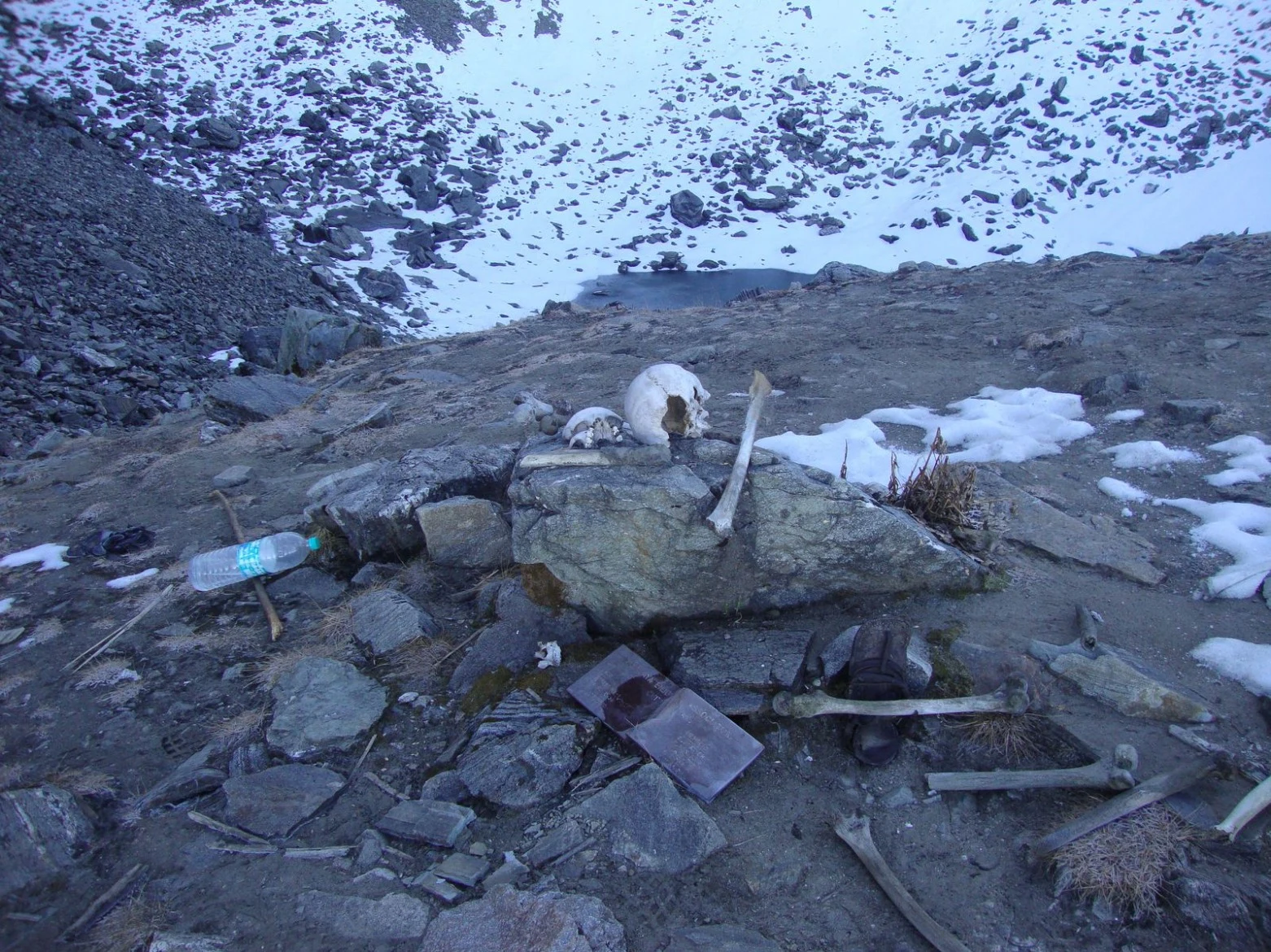
In 2005 Down To Earth lamented that the local administration had made no organised attempt to protect the site, and that the remains and artefacts were reported to be diminishing fast. 12 Sixteen years later BBC Travel described skeletons moved around by trekkers and taken home as souvenirs. 5 Vallangi also traced a wider change. In 2009 a Bengaluru-based company launched an affordable group trek to Roopkund that could be booked online. The route helped create a commercial Himalayan trekking scene in India, and with it, she writes, much environmental degradation. 5 By 2021, she noted, several people had lost their lives in pursuit of Roopkund over the previous decade. 5
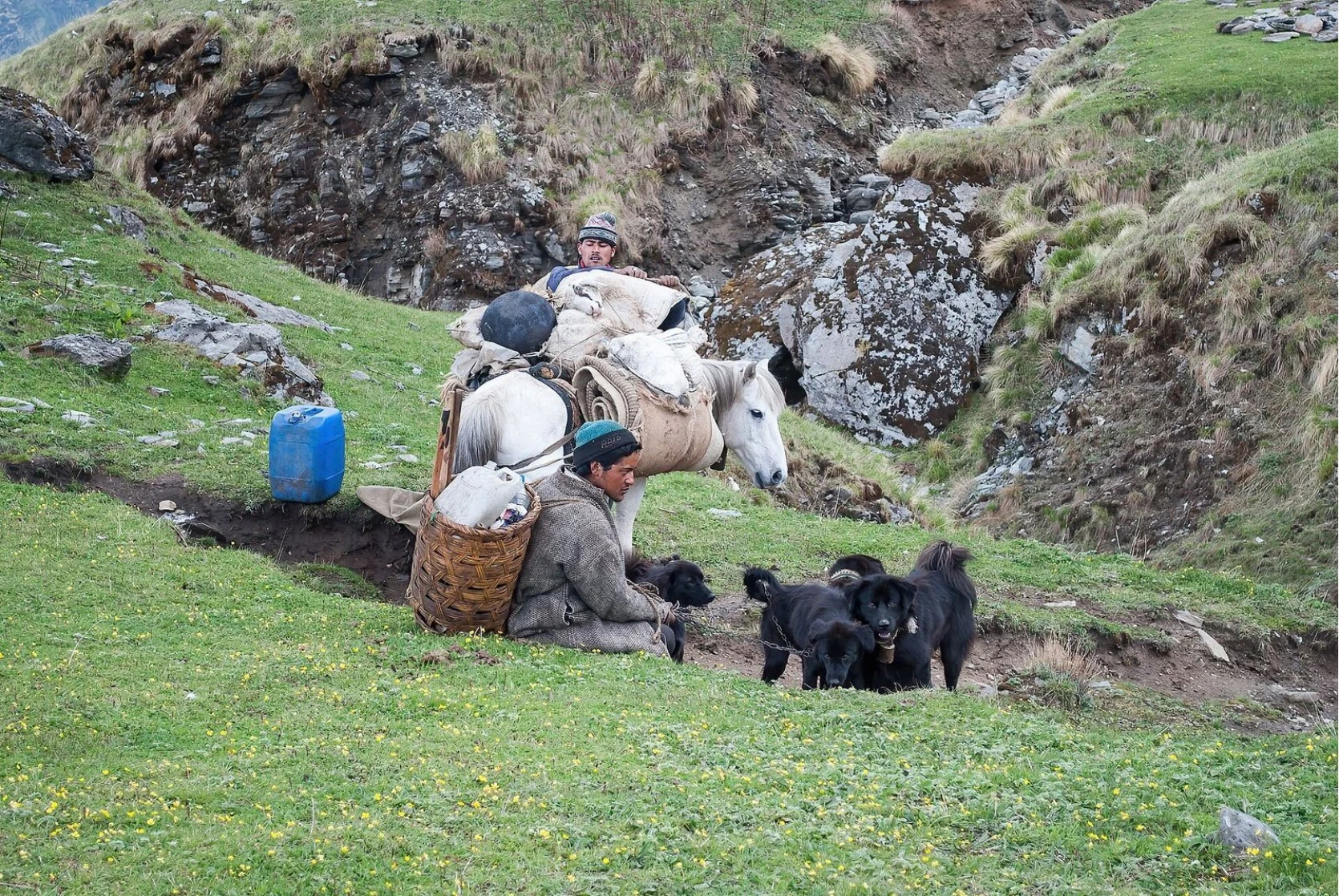
The pressure eventually reached the courts. In 2014 a society registered in Lohajung, the Aali-Bedini-Bagzi Bugyal Sanrakshan Samiti, filed a public-interest petition to protect the meadows below Roopkund. 21, 8 On 21 August 2018 the Uttarakhand High Court ruled on it. The court ordered permanent structures removed from the state’s alpine meadows within three months, limited visitors to no more than 200, banned overnight stays in the bugyals and banned commercial grazing, among other directions. 8, 21 Since the classic route camps on the bugyals, the order effectively closed it. 6 BBC Travel in 2021 described the Roopkund trek as inaccessible because of the ban. 5
According to July 2026 reporting on the state’s appeal, the Supreme Court on 20 July set aside three directions: the cap of 200 visitors, the blanket ban on overnight stays, and the direction to consider declaring the bugyals national parks or sanctuaries. The reports say the other conservation directions remain in force and that the Badrinath Forest Division instructed its officers to implement the decision. 22, 23 Local reporting greeted the decision as relief for homestays, guides and porters. 23 By October 2026 trekking companies were advertising the Roopkund trek as reopened, with group departures that month. 6 Whether it also means more feet, more litter and fewer bones remains to be seen.
The reporting cited here concerns meadow conservation and access. It does not establish a dedicated protection or excavation programme for the human remains. Reopening a route does not, by itself, protect the evidence along it.
What we know, what we infer, what we don’t
It helps to sort the claims by how well they are supported.
Established
The lake holds the disturbed remains of hundreds of people; precisely where and how each person died is unknown. 1, 2 The 38 individuals with genomes fall into three distinct ancestry groups: 23, 14 and 1. 1 The two main groups died roughly 1,000 years apart; the earlier group probably in more than one event. 1 The groups ate differently over the last decade or two of life. 1 Men and women were both present; none of the 38 were close kin. 1 The lake lies on the route of a living pilgrimage to Nanda Devi. 1, 7
Interpreted
Some of the earlier dead died during a pilgrimage (“plausible,” in the authors’ word). 1 Hail may have killed some people; the direct evidence is a handful of fractured skulls. 1, 5 The later group may have travelled from the eastern Mediterranean during the Ottoman period, perhaps from an inland area. 1 Most victims may have died of exposure (Mushrif-Tripathy’s view). 2
Unknown
Why the eastern Mediterranean group was here, and how they died. 1 How many separate events there were, and how many people died in each. Whether the 38 sequenced people represent the hundreds who died. 5 What lies on the lake bed, which has never been systematically examined. 2
What would change the answer
Roopkund is not a closed case, and it is unusually clear what kind of evidence could move it.
A systematic excavation. The collections discussed here were not recovered through a systematic excavation that recorded each find in context. Surface collection can bias a sample and weaken the links between bones, objects and location. 2 Mushrif-Tripathy believes a careful excavation could solve the mystery, especially if it reached the lake bed, where ice has protected the remains from looters for most of the year. “Inside the lake, you can get more preserved bones with soft tissues,” she said. “And if they are Greek people we should get some artifacts or tools or something which we can trace back to Greece.” 2
More of the dead. The 2019 study had genomes for 38 people out of hundreds. As BBC Travel asked, if 38 samples produced such a surprise, what else might the rest hold? 5 A larger, better-documented sample could show whether the groups are as sharply separated as they look, and whether other groups are present.
The archives. The B group died within the last few centuries, a period with written records. A diary, a missionary letter, a trading-company ledger or a colonial report of a foreign party lost in the Garhwal mountains would transform the question. The paper itself calls this an important direction. 1
The collection’s paper trail. The consistency of the B group’s results is an argument against a random storage mix-up, rather than a complete answer to questions of provenance. 2 A documented history of where each bone in the collection was picked up, and when, would provide an independent check, and would tell us which part of the lake each group came from. That is our suggestion, not one we found in the sources.
Better tests for cause of death. Pathogen DNA might have been missed simply because it was too scarce in long-bone powder. 1 Fracture patterns linked to genetic groups and dates could show whether the hail injuries belong to one event or several. For now, the evidence for hail rests on a handful of skulls. 5, 1
The open question
It is tempting to say that science corrected the legend. That is not quite what happened. The legend spoke of a pilgrimage, a royal party breaking the rules, and a storm of hail on the ridge. The 2004 team found hail-like injuries and pilgrims’ belongings, and the 2019 team called a pilgrimage death plausible for at least some of the earlier dead. 2, 1 The study tests the timing and ancestry of the sampled people. It neither verifies the royal legend nor settles its religious meaning. What it overturns is the idea that one catastrophe accounts for all the remains.
What we have instead is a lake that gathered its dead over a thousand years. Some died in the centuries around 800 CE, from many parts of South Asia, men and women, in more than one event; the precise number of incidents remains uncertain. A single Southeast Asian man died much later. And a group of unrelated men and women whose ancestry lies in the eastern Mediterranean died here in the last few centuries, in what may have been a single terrible event that has not been identified in the oral accounts discussed here. 1, 2
Hail may have killed some of them. Exposure is another plausible explanation. Sax’s near-fatal experience conveys the danger of the setting, but cannot tell us how these particular people died. 2 The lake did not choose them. The route did, and whatever brought them to it.
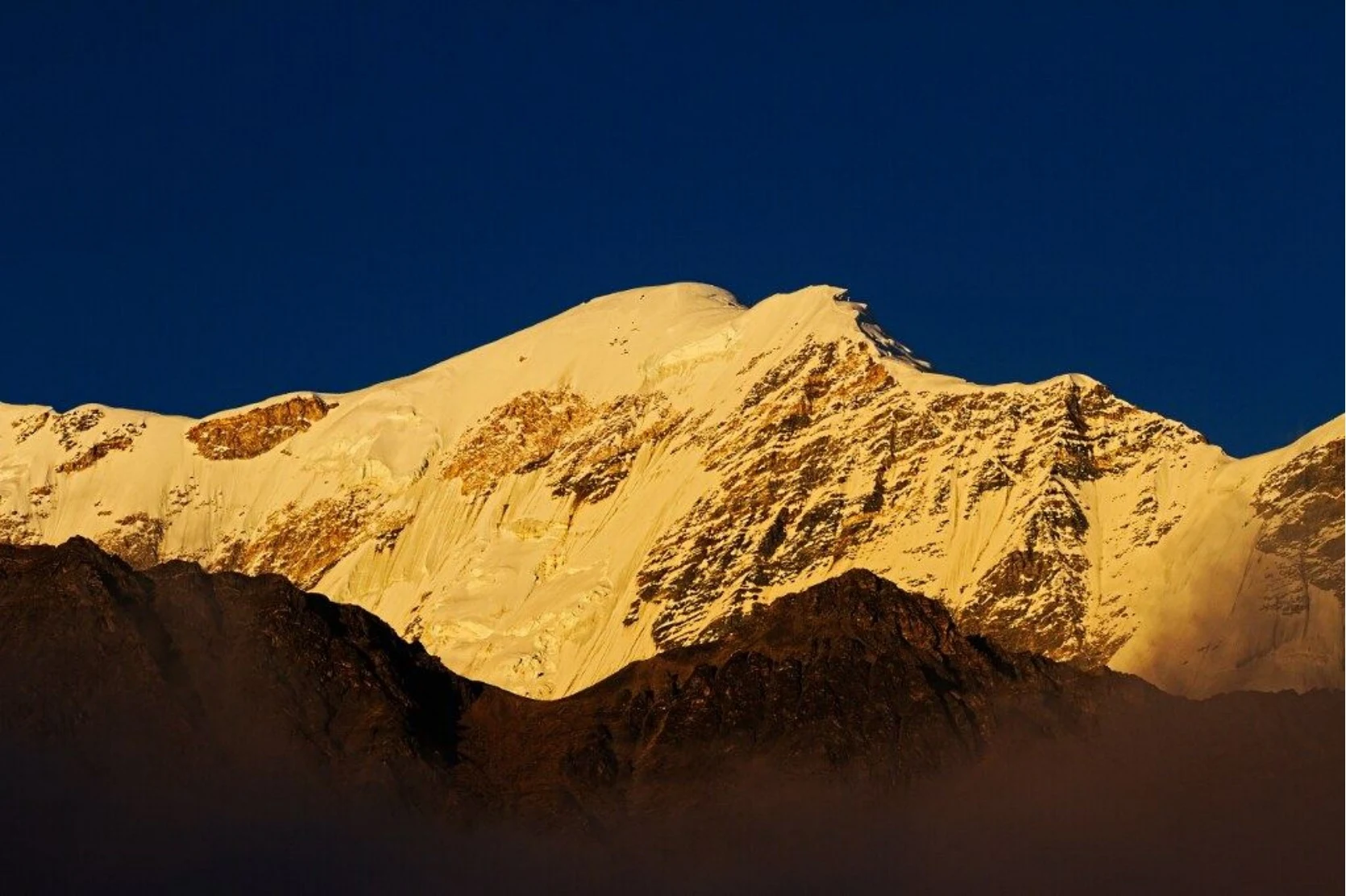
So the honest place to end is with the question the bones still put to us. Not “what happened at Roopkund?” as if there were one answer, but this: who were the people of the second group, and what brought fourteen men and women with roots in the eastern Mediterranean to a frozen lake on a goddess’s road, a few lifetimes ago, whose identities remain unknown?
Sources & further reading
- Harney, É. et al. · “Ancient DNA from the skeletons of Roopkund Lake reveals Mediterranean migrants in India” · Nature Communications 10, 3670 (2019), CC BY 4.0
- Douglas Preston · “The Skeletons at the Lake” · The New Yorker, 7 Dec 2020 (issue of 14 Dec 2020)
- Soutik Biswas · “The mystery of India’s ‘lake of skeletons’” · BBC News, 28 Feb 2021
- Kristin Romey · “DNA study deepens mystery of lake full of skeletons” · National Geographic, 20 Aug 2019 (subscriber article)
- Neelima Vallangi · “The unsolved mystery of Skeleton Lake” · BBC Travel, 6 Jul 2021
- Himalaya Trekkers · Roopkund trek itinerary (operator’s stage altitudes and distances), accessed Oct 2026
- Kautilya Singh · “Nanda Devi Raj Jat yatra, held every 12 yrs, postponed by a yr due to ‘erratic climate’ in high Himalayas” · The Times of India (Dehradun), 19 Jan 2026
- High Court of Uttarakhand · Aali-Bedini-Bagzi Bugyal Sanrakshan Samiti v. State of Uttarakhand, PIL decided 21 Aug 2018 · Indian Kanoon
- Siddhartha Sen · “The Himalayan Mahakumbh: A recount of a once-in-12-year experience” · Zee News, 22 Sep 2014
- Drashokk · file description of “Kalua Vinayak temple, Chamoli” (photographed June 2009) · Wikimedia Commons
- Dainik Bhaskar (Hindi) · on the Nanda Devi Badi Jat reaching Shila Samudra and Homkund, Sep 2026
- Rajshekhar Pant · “Skeleton Lake” · Down To Earth, 31 Aug 2005
- Alka Barthwal · “Roopkund Human Skeletal Remains: A Short Note on the Signs of Nutritional Stress and Anemia on the Cranial and Orbital Surface” · in Animals in Archaeology, vol. 2 (Festschrift for P. P. Joglekar), 2023 · abstract and bibliography
- Vivekananda International Foundation · “Looking Back at General Zorawar Singh and his Campaigns: An Assessment”, 22 Mar 2024
- Dhaval Kulkarni · “Team unravels bones’ mysteries” · The Times of India (Pune), 31 Oct 2004
- Vinay Bahuguna · A guide to the Nanda Devi Raj Jat · Amar Ujala (Hindi), 7 Aug 2014
- Vinay Bahuguna · Raj Jat records and its irregular intervals · Amar Ujala (Hindi), 15 Aug 2013
- PTI · “Ukhand: Nanda Devi Raj Jat yatra postponed to 2027” · ThePrint, 18 Jan 2026
- Shailendra Semwal · Successful completion of the Nanda Devi Badi Jaat 2026 · Live Hindustan (Hindi), 5 Oct 2026
- ETV Bharat (Hindi) · on the completion of the Homkund puja of the Nanda Devi Badi Jat, 22 Sep 2026
- Neeraj Santoshi · “Uttarakhand high court restricts number of tourists at alpine meadows to 200” · Hindustan Times, 23 Aug 2018
- ETV Bharat (Hindi) · on the Supreme Court order of 20 Jul 2026 and the Badrinath Forest Division’s instructions, Jul 2026
- Kalika Prasad Sirswal · on the Supreme Court lifting the bugyal night-stay ban · Dainik Jagran, 29 Jul 2026
- S. K. Juyal · “The paleodietary reconstruction of Roopkund skeletons through trace element analysis” · Indian Journal of History of Science 59, 269–273 (2024)

Further reading: William S. Sax, Mountain Goddess: Gender and Politics in a Himalayan Pilgrimage (Oxford University Press, 1991). Image credits and licences are given in each caption.